
Twisting Postures in Yoga: Master Your Rhomboids
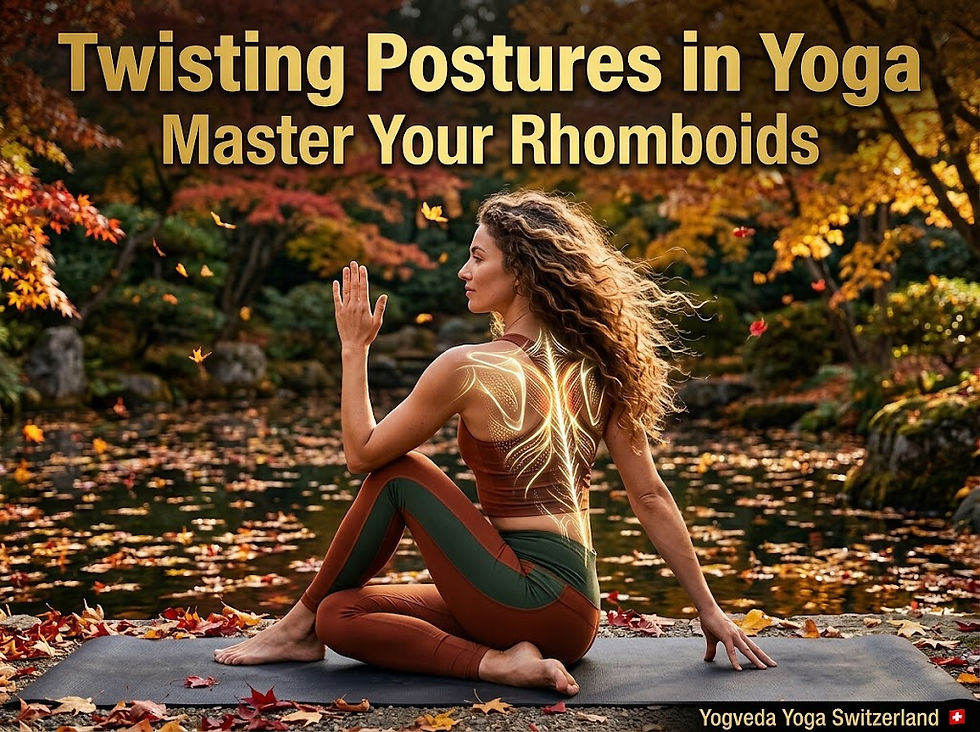
Have you ever sat in a seated twist, grabbed your opposite knee with your hand, and violently yanked your torso to look over your back shoulder?
Have you ever been instructed by a commercial studio teacher to use your arms as leverage to "wring out your toxins" or "twist just a little deeper"? It sounds like advanced practice. It looks dramatic.
In applied biomechanics, it is a clinical disaster. Congratulations, you just started a butterfly effect to damage your spinal discs.
When you use your arms as crowbars to force a spinal rotation in twisting postures, do you think you are improving your mobility? You are not. You are actively shredding your sacroiliac (SI) joint, overstretching your spinal ligaments, and completely bypassing the very muscles designed to rotate your skeleton safely.
In Part 4 of our 5-day biomechanical series on the Trapezius and the Rhomboids, I am deconstructing the advanced anatomy of Twisting Postures in Yoga (Parivṛtta). If you want to protect your lower back and build a functional spine, you must stop wrenching your body with your hands and start mastering the divided, dual-action work of your scapular anchors.
The Fatal Error in Twisting Postures: The "Leverage and Crank" Trap
Have you ever noticed a sharp, localized pinch at the base of your spine after a sequence of deep twisting postures?
The commercial yoga industry treats twists as a passive stretching exercise. Instructors cue students to lock their pelvis and twist as far as humanly possible using arm leverage. Do you know what your anatomy actually dictates during this movement?
1. The Lumbar Lockout in Twisting Postures
Your lumbar spine (lower back) is designed to bend forward and backward, not to rotate. The facet joints (the connections between the vertebrae) in your lower back align vertically, physically locking into each other. This allows a maximum of only 5 to 7 degrees of total rotation. When you lock your hips and use your arms to crank your torso in twisting postures, that twisting force hits a solid bone wall.
2. Sacroiliac (SI) Joint Shearing from Twisting Postures
If your lower back bones cannot physically twist, where does that violent leverage go? It travels straight down into the sacroiliac joint in your pelvis. The SI joint is a highly stable, weight-bearing shock absorber, not a twisting hinge. By using your arms to force a deep twist, you introduce extreme shearing force into the pelvic ligaments. This is exactly how modern "deep twists" systematically tear the SI joint apart and destabilize the pelvis.
3. The Dead Shoulder Blade in Twisting Postures
When you twist by pulling with your hands, your shoulder blades become dead weight. Your arm muscles do all the pulling, while your back muscles switch off entirely. You are merely working ON your joints by applying an external twisting force to a passive, vulnerable spine, rather than working WITH your deep back muscles to create a safe, active rotation.
The Biomechanical Reality of Twisting Postures in Yoga: The Dual-Action Shoulders
Your mid-back (the thoracic spine) is uniquely designed for rotation because its joints glide horizontally. But do you know how your shoulder blades must actually operate to drive this safe, active spinal twist?
In Forward Extensions, your Rhomboids work symmetrically to hold you back. In Backward Extensions, they work symmetrically to wedge your chest forward.
In Twisting Postures, however, your shoulder blades must split their jobs. They have to execute two completely different actions at the exact same time:
1. The Pulling Muscle (The Retreating Shoulder in Twisting Postures)
Take a twist to the right. Your right shoulder is moving backward. To achieve this safely, your right Rhomboid must actively shorten (concentric contraction). You do not just passively squeeze it; you must work WITH this right Rhomboid, using its strength to actively pull the right side of your rib cage backward and drive the twist.
2. The Controlled Brake (The Advancing Shoulder in Twisting Postures)
Simultaneously, your left shoulder is moving forward. Your left Rhomboid cannot simply go limp or turn off. It must lengthen under tension (eccentric contraction). You must work WITH this left Rhomboid to act as a slow, controlled brake. It manages the forward glide of the left shoulder blade to keep your chest broad, your collarbones wide, and your upper spine stable.
3. The Uncompromising Law of Downward Movement for Twisting Postures
While your left and right Rhomboids are doing opposite jobs, your Trapezius muscles have a non-negotiable, shared directive: both shoulders must uncompromisingly move downwards. The Lower Trapezius must fire aggressively on both sides to pull the shoulder blades away from your skull. If your back shoulder hikes up to your ear as you twist, Cranial Nerve XI fires a panic signal, your neck compresses, and you physically choke off your ability to breathe and rotate in twisting postures.
Technical Yogveda Asana Protocols: Re-Engineering Twisting Postures like Ardha Matsyendrāsana
Yoga asanas were never meant to be a war against your own anatomy. Twisting postures in yoga are designed to remove physical blockages so neurological energy flows freely, not to wring out your spinal discs like wet rags.
How do you apply these rules on the mat? Let us deconstruct a highly misunderstood seated twist: Ardha Matsyendrāsana (Half Lord of the Fishes Pose).
How to Execute Twisting Postures:
1. Grow Tall First (Pratāna): You cannot safely twist a compressed spine. Ground your sitting bones firmly into the mat. Engage your core and drive the crown of your head straight up to lengthen the spine. You must create maximum space between your spinal bones before you even think about turning in twisting postures.
2. The Internal Engine (Core to Thoracic): Start the twist using your core strength. Fire your obliques to initiate the rotation, and then transition the movement actively into the thoracic spine. Do not use your front arm to push against your knee and crank your ribs around.
3. The Downward Trapezius: As you rotate, ensure the Trapezius is uncompromisingly moving downwards. You must forcefully pull both shoulders away from your ears so the cervical spine can turn without pinching.
4. Working WITH vs. ON the Rhomboids: Finally, work with the Rhomboids to get the shoulder blades together, using their strength to actively open the chest. If you cannot do that—if your upper back feels frozen or weak—you must take a step back. You must use the shoulder blades to work on the Rhomboids. Deliberately draw the blades toward the spine simply to wake the dormant tissue up. As we have established throughout this series, you cannot work with a muscular engine that your brain cannot locate.
The Yogveda Prescription for Twisting Postures
In our current 4-week cycle at Yogveda Yoga, we are dismantling the dangerous "crank and pull" habits of commercial yoga. We are teaching practitioners how to stop fighting their bodies and master the dual-action Rhomboid engine, ensuring every twisting posture is active, structurally sound, and completely free of joint pain.
Tomorrow, in Part 5—the final installment of this series—I will integrate everything we have learned into the ultimate test of biomechanical mastery: Inversions and Weight-Bearing Arm Balances. I will expose how failing to organize your Trapezius and Rhomboids upside down destroys the neck, and how to build a structural bridge that defies gravity.
Scientific References & Academic Grounding for Twisting Postures
Lumbar vs. Thoracic Kinematics: Neumann, D. A. (2010). Kinesiology of the Musculoskeletal System: Foundations for Rehabilitation. Mosby. (Confirms that the nearly vertical alignment of lumbar facet joints mechanically blocks rotation, while the frontal-plane orientation of thoracic facet joints allows for optimal, safe axial rotation).
Lumbar Spine Rotational Limits: Bogduk, N. (2005). Clinical Anatomy of the Lumbar Spine and Sacrum. Elsevier Churchill Livingstone. (Proves that the facet joint orientation mechanically restricts lumbar axial rotation to a maximum of 1-3 degrees per segment, rendering "deep lower back twists" physiologically impossible without damage).
Sacroiliac Joint Shear Stress: Vleeming, A., et al. (2012). The sacroiliac joint: an overview of its anatomy, function and potential clinical implications. Journal of Anatomy, 221(6), 537-567. (Documents how excessive rotational torque transferred from a locked lumbar spine during twisting postures creates acute pathological shear forces within the SI joint ligamentous network).
Asymmetrical Scapular Control: Ludewig, P. M., et al. (2009). Motion of the shoulder complex during multiplanar humeral elevation. Journal of Bone and Joint Surgery, 91(2), 378-389. (Demonstrates the clinical necessity of distinct, asymmetrical scapulothoracic force couples—concentric pulling vs. eccentric braking—during rotational movements).
Active vs. Passive Spinal Safety: McGill, S. M. (2007). Low Back Disorders: Evidence-Based Prevention and Rehabilitation. Human Kinetics. (Establishes that applying external leverage to a rotated spine bypasses active neuromuscular protective mechanisms, directly increasing the risk of intervertebral disc herniation).
Your Applied Science Reflection on Twisting Postures in Yoga: Sit on the floor and prepare for Ardha Matsyendrāsana. Hook your elbow outside your raised knee, plant your other hand behind you, and push against your arm as hard as you can to twist your chest backward. Feel the tension in your lower back and the absolute dead weight of your back muscles.
Now, reset. Take both hands completely away and let them hover one inch off the skin/floor without resting. Start the twist using only your core strength, then rotate the thoracic spine. Ensure your Trapezius is moving downwards. Actively work with your Rhomboids to open your chest asymmetrically.
Notice how much harder your muscles have to work, and notice the complete absence of grinding pressure in your lower spine. That is your true twisting capacity. That is the difference between blindly cranking your joints in twisting postures and applied biomechanical mastery.
Yogveda Manifesto
Yogveda Yoga is a compiled applied science. We do not follow "isms," dogmas, or blind beliefs. Rooted strictly in the classical Darśanas and Ayurveda, we dictate no human morality and teach no god worship. We simply provide the exact tools to study your own biological engine. Freedom is absolute self-knowledge. Study yourself to be free.
👉 Yogveda Asana Lesson : Build the physical presence to distinguish between what is real in the body and what is just a feeling.
👉Yogveda Yoga Teacher Training in Bern: Deepen your understanding of Patanjali's philosophy of mind and truth.
Author, Master Shahid Khan
Yogveda Yoga Switzerland 🇨🇭



Comments