
What Are the Rhomboids and Trapezius? Stop Destroying Them
Have you ever wondered why your neck is constantly stiff, your upper back aches, and your posture is collapsing forward? You probably blame it on emotional stress, a bad mattress, or aging.
This is a biological excuse. You are not simply stressed; you are suffering from a measurable mechanical failure.
To engineer a functional body, you must first understand the machinery. In Part 1 of this 5-day biomechanical series, I am deconstructing the architecture of your upper back. If you do not understand how to operate the primary anchors of your shoulders, you will spend your entire life in chronic physical and neurological pain.
What are the Rhomboids and the Trapezius?
Do you know what actually holds your arms to your skeleton?
Unlike your hip joint—which is a deep, bone-enclosed ball-and-socket—your shoulder blade has no direct bony joint connecting it to your spine. In functional anatomy, the connection between your shoulder blade and your rib cage is known as the scapulothoracic sliding joint. It is a physiological articulation. Your shoulder blades literally float on a muscular web over the back of your rib cage.
This anatomical design provides massive mobility, but it demands absolute mechanical stability. The primary architects of this stability are your Rhomboids and your Trapezius.
These are not aesthetic muscles designed for bodybuilding mirrors. Clinically speaking, they are your primary scapulothoracic anchors. They dictate whether your shoulder blades glide smoothly in a healthy 2:1 scapulohumeral rhythm or grind your cervical and thoracic spine into a compressed, painful collapse.
Where are these biomechanical anchors located?
Do you know the exact anatomical coordinates of these anchors?
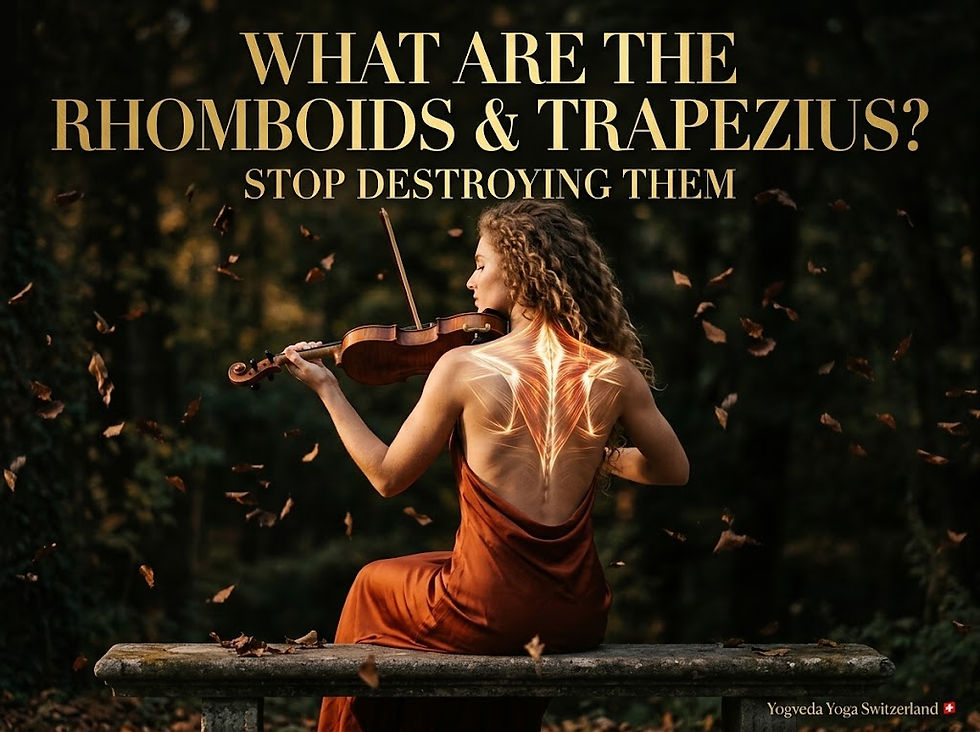
The Rhomboids (Major and Minor): These sit beneath the Trapezius. The Rhomboid Minor originates from the nuchal ligament and the spinous processes of C7 and T1, attaching to the medial border of the scapula at the root of the spine. The Rhomboid Major originates from the spinous processes of T2 through T5 and inserts along the medial border down to the inferior angle. They form an oblique muscular bridge pulling the shoulder blade upward and inward toward your spine.
The Trapezius: This is a massive, diamond-shaped superficial sheet split into three functionally distinct zones:
Descending (Upper) Trapezius: Runs from the base of the skull (external occipital protuberance) and nuchal ligament down to the lateral third of your clavicle.
Transverse (Middle) Trapezius: Runs from the spinous processes of C7 through T3 horizontally to the acromion and upper spine of your shoulder blade.
Ascending (Lower) Trapezius: Runs from the spinous processes of T4 through T12 upward to attach to the spine of your shoulder blade.
What is their clinical mechanical function?
What happens mechanically when these muscle chains fire? They control the multidirectional excursion of your shoulder blades:
Scapular Retraction
The Rhomboids and the Middle Trapezius pull your shoulder blades together toward the midline of your spine.
Scapular Depression
The Lower Trapezius pulls the inner edge of your shoulder blade down your back toward your pelvis, anchoring it away from your ears.
The Rotational Force Couple
To raise your arms overhead without pinching the rotator cuff (impingement), the Upper and Lower Trapezius must work with the Serratus Anterior to rotate the shoulder blade upward. Concurrently, the Rhomboids act as dynamic brakes, controlling downward rotation and preventing the shoulder blade from winging off your rib cage.
Together, they form the structural anchor for your upper body. When you push, pull, or carry an object, these muscles lock the shoulder blade onto the rib cage so your arm has a stable foundation to generate force without damaging your neck.
What happens to your body when these muscles get weak?
Have you noticed that your shoulders perpetually round forward and your chin juts out?
When your Rhomboids and Lower Trapezius lose their functional tone, you enter a clinical state known as Upper Crossed Syndrome (originally cataloged by Dr. Vladimir Janda). Because the Rhomboids and Lower Trapezius are no longer anchoring the shoulder blade down and back, they enter an eccentric failure state—they become "locked long" (chronically overstretched, neurologically inhibited, and weak).
To compensate for this structural failure, your Upper Trapezius and Levator Scapulae become hyperactive. They become "locked short." Your shoulders permanently hike toward your ears.
This mechanical breakdown triggers a severe neurological cascade:
The Stress Loop: The Trapezius is innervated by Cranial Nerve XI (the Spinal Accessory Nerve). When your upper traps are locked in a permanent shrug, they mimic the primal startle reflex. This chronic contraction feeds directly back into your brainstem, signaling continuous survival threat.
Respiratory Collapse: Chronically elevated shoulder blades force you to recruit your neck muscles as accessory breathers. This shuts down diaphragmatic excursion, locking your autonomic nervous system into a chronic, sympathetic fight-or-flight loop. Weak shoulder blades do not just ruin your posture; they biologically manufacture anxiety.
How did you actually make them weak?
Did this dysfunction happen by accident? No. You systematically trained your body into this failure through daily postural collapse.
You sit at a desk, hunch over a steering wheel, and stare down at a smartphone for eight to twelve hours a day. By keeping your arms permanently forward, your shoulder blades remain in chronic protraction (pulled apart).
Your brain operates on the principle of biological economy: tissue adapts to the positions it inhabits most. By holding protracted shoulders all day, you send a continuous neurological signal to your Rhomboids and Lower Trapezius to down-regulate, conserve ATP, and atrophy.
Why is the gym actively destroying your shoulder mechanics?
Have you been told that lifting weights at the gym will fix your upper back?
Mainstream fitness culture is actively worsening scapulothoracic dysfunction because it prioritizes aesthetic muscle hypertrophy over integrated biomechanics:
The Bench Press Trap: When you lie flat on a bench, standard gym culture instructs you to pin your shoulder blades back and down into the pad and keep them locked there while pressing a heavy barbell. This completely immobilizes the scapulothoracic joint, destroying the natural glide of the shoulder blade and turning off dynamic serratus-trapezius coordination.
The Isolation Error: When you perform heavy, machine-guided rows or lat pulldowns without clinical cueing, your overactive Upper Trapezius and biceps immediately take over the load. You pull with your arms instead of initiating from the scapular anchors. You build thick, hypertonic surface muscle over an unstable, dysfunctional skeletal frame.
Bodybuilding isolates muscles to induce hypertrophy; human biomechanics requires integrated force couples. By loading a dysfunctional shoulder girdle with heavy weights, you cement your poor mechanics into your nervous system.
The Yogveda Prescription
You cannot repair a structural failure with positive thinking, massages, or random gym exercises. You must apply strict biomechanical intervention.
In our current 4-week cycle at Yogveda Yoga, we are focusing intensely on the mechanical restoration and activation of the Rhomboids and Trapezius.
Tomorrow, in Part 2 of this series, I will break down the exact biomechanics of Forward Extensions—exposing why pulling yourself down with your arms destroys your cervical spine, and how to use eccentric scapular control to decompress your back.
Scientific References & Academic Grounding
Scapulohumeral Rhythm & Biomechanics: Inman, V. T., Saunders, J. B., & Abbott, L. C. (1944). Observations on the function of the shoulder joint. Journal of Bone and Joint Surgery, 26(1), 1–30. (Establishes the mandatory 2:1 kinetic coordination between the arm and shoulder blade).
Upper Crossed Syndrome & Muscle Imbalance: Janda, V. (1988). Muscles and motor control in cervicogenic disorders. Physical Therapy of the Cervical and Thoracic Spine, 182–199. (Documents the clinical pattern of locked-long rhomboids and hyperactive upper trapezius).
Trapezius Muscle Imbalance & Neck Pain: Cools, A. M., et al. (2007). Rehabilitation of scapular muscle balance: which exercises to train the upper, middle, and lower trapezius? American Journal of Sports Medicine, 35(10), 1744–1751. (Validates how upper trapezius dominance inhibits lower trapezius activation).
Accessory Respiration & Autonomic Stress: De Troyer, A., & Estenne, M. (1988). Functional anatomy of the respiratory muscles. Clinics in Chest Medicine, 9(2), 175–193. (Demonstrates how overactivity in upper neck and shoulder stabilizers disrupts normal diaphragmatic mechanics).
Your Applied Science Reflection: Stand upright and let your arms hang naturally by your sides. Look down at your hands. Are your thumbs pointing forward, or are the backs of your hands facing forward?
If the backs of your hands face forward, your shoulders are internally rotated and your Rhomboids are locked long.
Do not simply yank your shoulders backward with your neck. Instead, consciously depress your shoulder blades: slide the bottom tips of your shoulder blades down toward your back pockets, and feel your sternum lift naturally. Notice how this single mechanical adjustment instantly frees your throat and expands your breathing capacity.
Yogveda Manifesto
Yogveda Yoga is a compiled applied science. We do not follow "isms," dogmas, or blind beliefs. Rooted strictly in the classical Darśanas and Ayurveda, we dictate no human morality and teach no god worship. We simply provide the exact tools to study your own biological engine. Freedom is absolute self-knowledge. Study yourself to be free.
👉 Yogveda Asana Lesson : Build the physical presence to distinguish between what is real in the body and what is just a feeling.
👉Yogveda Yoga Teacher Training in Bern: Deepen your understanding of Patanjali's philosophy of mind and truth.
Author, Master Shahid Khan
Yogveda Yoga Switzerland 🇨🇭


Comments