
Yogveda Biomechanics: Transversus Abdominis — Why a Weak Core Causes Back Pain, Neck Strain & Short Breaths (And The 15 "Core Dynamic" Postures)

Have you ever wondered why, after standing for just fifteen minutes, a dull, exhausting ache sets into your lower back?
Or have you ever caught yourself aggressively pulling your stomach in at your desk—trying to hold "good posture"—only to realize your neck feels stiff, your shoulders are creeping toward your ears, and you cannot take a full, deep breath?
If you practice yoga, Pilates, or work out in a gym, you have almost certainly heard the standard command: "Draw your navel to your spine."
Millions follow this instruction believing they are protecting their spine and building deep core strength. But laboratory spine biomechanics reveal a completely different reality: Peer-reviewed clinical research (e.g., Grenier & McGill, 2007) proves that this "hollowing" cue actually reduces lumbar spinal stability by up to 32%. Instead of protecting your back, pulling your navel inward robs your lumbar vertebrae of their hydraulic support, shoves downward pressure onto your pelvic floor, locks your diaphragm, and strains your cervical spine.
In clinical biomechanics and the authentic classical science of the darshanas, your body’s true stabilizer is not an aesthetic suction trick. It is an authentic hydraulic engine: the Transversus Abdominis (TVA).
Your Transversus Abdominis does not work by collapsing your abdominal wall inward like an empty cave. It acts like an unyielding horizontal belt that creates 360-degree Intra-Abdominal Pressure (IAP) and pulls the Thoracolumbar Fascia taut, converting your lumbar spine into an unshakeable, decompressed column.
Directly above the pelvic floor (Mūla Bandha), the TVA acts as the physical engine for Uḍḍīyāna Bandha ("the upward flying lock"). When engaged properly on a complete exhale, it generates a true physical vacuum that lifts your organs, offloads compressive disc stress, and directs life force (prāṇa) up the central channel of your spine (suṣumṇā nāḍī) from the root to the heart center.
To restore this critical neuromuscular coordination, Master Shahid Khan engineered "Core Dynamic"—a signature masterclass curriculum built upon 15 foundational postures.
As Post 5 of our 8-Week Yogveda Core, Posture & Breath Stabilization Program, let us bridge university-level orthopedic science with your real-world movement experience.
1. Functional Anatomy: How Does Your Deep Corset Really Function?
Have you ever visualized the fiber direction of your abdominal muscles? Most people picture their core as the vertical blocks of a "six-pack" (Rectus Abdominis) or the diagonal cuts at the flanks (Obliques).
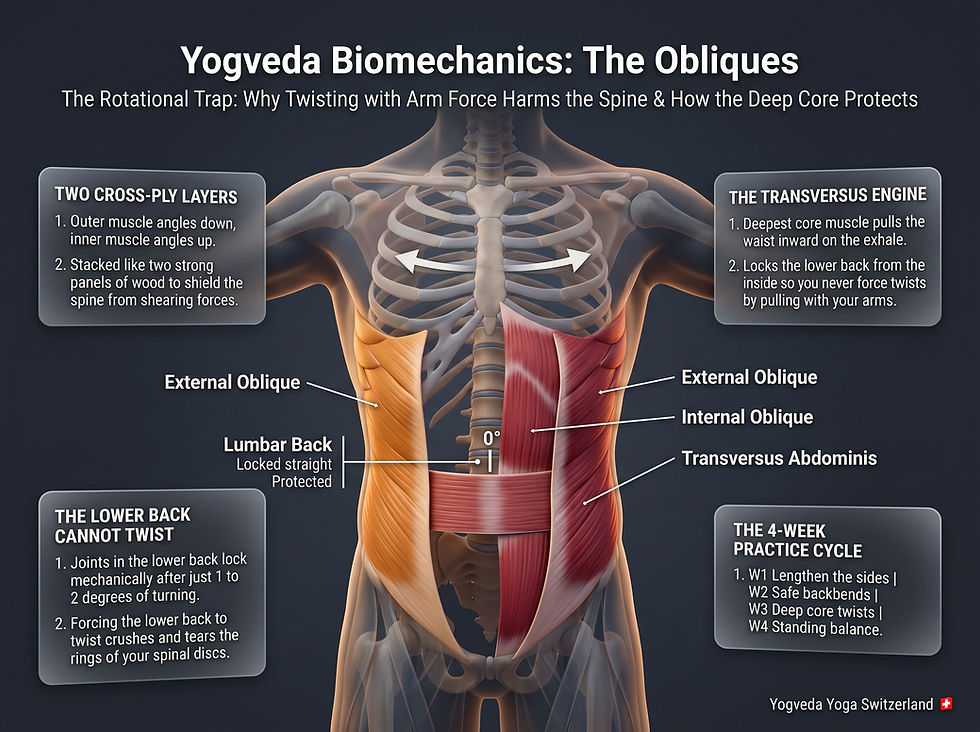
The Transversus Abdominis is fundamentally different: Its muscle fibers run strictly horizontally. It wraps around your entire waist like an internal, seamless weightlifting belt forged from living muscle and high-tensile fascia.
A. The Diaphragmatic Interlock: Why Breath and Core Rise Together
Have you ever noticed your breath freeze the instant you suck your stomach in? That is an anatomical certainty: Your primary breathing muscle and your deepest core stabilizer physically interlock along ribs 7 through 12 like clasped fingers. If your Transversus Abdominis is frozen or weak, your diaphragm cannot descend properly. Shallow stress breathing and core instability are two sides of the same mechanical coin.
B. Feedforward Motor Control: The 110-Millisecond Protection Reflex
In an uninjured spine, your nervous system executes an involuntary reflex: The Transversus Abdominis fires automatically 30 to 110 milliseconds BEFORE you move your arm or leg (Hodges & Richardson, 1996). It is an anticipatory postural reflex. The brain stabilizes the lumbar joints in advance so that limb movement does not whip the vertebrae. In people with chronic back pain, this reflex is broken—the limb moves first, and the unprotected lumbar joints take the blunt force.
2. Systemic Collapse: How a Weak Core Drives Back Ache, Neck Strain, Short Breaths & Spinal Disc Instability
When the Transversus Abdominis fails to fire, intra-abdominal pressure drops to zero. Gravity pulls your torso down, and your body compensates through three distinct mechanical breakdowns:
            [ THE SYSTEMIC POSTURAL COLLAPSE ]
                           │
     ┌─────────────────────┼─────────────────────┐
     ▼                     ▼                     ▼
[ 1. DISC MICRO-SHEARING ] [ 2. UPPER TRAP STRAIN ]  [ 3. RESPIRATORY DEADLOCK ]
Vertebrae slide under body Neck muscles hoist torso  Lower ribs stay pinned down;
weight; frays outer disc   upward; causes burning    breath trapped in neck;
rings (disc instability).  headaches and stiffness.  triggers chronic air hunger.
A. Spinal Disc Instability & Segmental Micro-Shearing (Panjabi’s Model)
Have you ever felt like your lower back has "micro-wobbles" or feels unstable when you bend forward to brush your teeth?
In orthopedic biomechanics, spinal stability relies on three interdependent systems (Panjabi's Model): the passive spinal column (bones and discs), the active muscles, and the neuromuscular control system. When the active muscular subsystem (the TVA) shuts off, spinal integrity breaks down:
Neutral Zone Expansion: Without horizontal hoop tension bracing the spine, individual vertebrae (predominantly L4–L5 and L5–S1) begin to slide forward and backward during basic movements (translational micro-shearing).
Annular Fraying & Disc Failure: Because the intervertebral disc must absorb these uncontrolled shear forces, the collagen rings of the outer disc (annulus fibrosus) stretch, delaminate, and tear. Over time, this leads directly to degenerative disc disease, facet arthrosis, and disc herniations.
B. The Neck Compensation: Why Your Shoulders Are on Fire
Have you ever wondered why your neck burns after doing ab workouts, or why your traps feel like rocks after sitting at your laptop?
Think about the physics: If your abdominal cylinder is not supporting your spine from underneath, your body must still hold itself upright against gravity. Your nervous system panics and recruits the muscles from above to hoist you up. Your upper trapezius, scalenes, and sternocleidomastoid contract continuously just to keep you from slumping forward. You do not have an isolated neck issue—you have an inactive deep core.
C. The Respiratory Deadlock: The Trap of "Air Hunger"
Do you ever catch yourself sighing heavily throughout the day, or feeling like your lungs can never quite fill to capacity?
Because the TVA anchors to ribs 7 through 12, a dormant or spasmed transversus locks your lower ribcage. Your ribs cannot swing outward like a bucket handle when you inhale. Your diaphragm slams into an unyielding wall, forcing air upward into your collarbones. This triggers an involuntary fight-or-flight response, keeping you in an anxious state simply because your core cannot breathe.
3. The Soda Can Physics: 360° Hoop Tension vs. The Navel-to-Spine Lie
To understand true stability, picture an unopened can of sparkling water:
Even though the aluminum wall is paper-thin, you can stand on that unopened can without crushing it. The internal fluid pressure easily supports your body weight.
Now puncture a tiny hole in the side, let the pressure hiss out, and step on it again. It crumples under the lightest touch.
Your abdominal cavity is engineered according to the exact same physical law.
When you draw your navel back to your spine, you punch a hole in your own pressure can. You narrow your base of support and slacken your back fascia.
When you activate the Transversus Abdominis correctly, its horizontal fibers tighten against your fluid-filled abdominal cavity like iron hoops around a barrel (radial hoop tension). Because your internal organs are non-compressible, this creates a rigid hydraulic column in front of your spine that absorbs up to 40% of axial vertical weight before it ever compresses a lumbar disc.
4. Uḍḍīyāna Bandha: The Mechanical Vacuum for Spinal Decompression
Have you ever tried doing a "stomach vacuum" by flexing your abs hard in the mirror? That is not Uḍḍīyāna Bandha.
In authentic Yogveda science, Uḍḍīyāna Bandha is an effortless, involuntary physical vacuum created on an empty breath:
You exhale completely until your lungs are completely empty. Your diaphragm relaxes and floats upward into your chest dome.
You hold the breath out (bāhya kumbhaka).
Without inhaling any air, you expand your ribcage outward (a "false inspiration").
As confirmed by clinical studies on hypopressive gymnastics (Caufriez et al.), expanding your ribs against an empty lung creates instant negative intra-abdominal pressure.
This natural vacuum effortlessly pulls your relaxed abdominal wall inward and upward under your ribs. It physically lifts your organs off your pelvic floor and pulls your L4–L5 vertebrae apart, creating instant axial decompression while drawing energy (prāṇa) up through the central suṣumṇā channel.
5. Master Shahid Khan's "Core Dynamic": The 15 Postures in Practice
How do you retrain this deep reflex so it protects you automatically, without wearing down your joints with sit-ups or planks?
Master Shahid Khan developed "Core Dynamic"—a focused 15-posture curriculum designed to train the Transversus Abdominis through its true biomechanical functions: anti-extension, anti-rotation, and upward hydraulic lift.
In our 12-month Yogveda curriculum, this 4-week cycle breaks down into four clear clinical stages:
        [ THE 4-WEEK DEEP CYLINDER CYCLE: CORE DYNAMIC ]
                               │
     ┌─────────────────────────┼─────────────────────────┐
     ▼                         ▼                         ▼
[ WEEK 1 ]                [ WEEK 2 ]                [ WEEK 3 ]                [ WEEK 4 ]
CORE DYNAMIC              BACK BENDS                TWISTING POSTURES         STANDING POSTURES
INTEGRATION               Eccentric Anterior        The TVA Engine:           360° Hydraulic
Deep Expiratory Recoil    Compliance & Shielding    Locking L1–L5 at 0°       Sovereignty Under Gravity
Week 1: Core Dynamic Integration — Expiratory Recoil & Pelvic Floor Sealing
In postures like Dynamic Nāvāsana and Utthān Pṛṣṭhāsana, the belly does not sag or pooch. On a full exhalation, you activate the pelvic floor and draw the TVA inward. This deep activation tightens the Thoracolumbar Fascia, stabilizes the lumbar spine against micro-shearing, and begins to decompress the sacral base.
Week 2: Back Bends — Never Pinch Your Lower Back Again
Have you ever felt a sharp pinch in your lower back when performing Cobra or Upward Dog? That happens when your core goes to sleep and your spine hinges in half. In Week 2, you learn to keep the TVA engaged under length (eccentric control). It maintains fluid pressure in front of your spine so your facet joints never collide.
Week 3: Twisting Postures — Turn From Your Deep Core, Not Your Arms
Stop pulling on your legs to wrench yourself into a twist. In Week 3, your exhale locks your lumbar spine safely at 0 degrees using pure Transversus strength. With your lower back locked against shear, your ribcage turns freely across its anatomical 35 degrees of rotation without wearing down your discs.
Week 4: Standing Postures — Stand Tall Without Fatigue
When you integrate all 15 postures on your feet, your body learns to absorb ground impact automatically. You no longer collapse into your hips or hunch your shoulders. You stand with genuine, effortless structural sovereignty.
Peer-Reviewed Scientific References
Hodges, P. W., & Richardson, C. A. (1996). Inefficient muscular stabilization of the lumbar spine associated with low back pain: A motor control evaluation of transversus abdominis. Spine, 21(22), 2640–2650.
Grenier, S. G., & McGill, S. M. (2007). Quantification of lumbar stability by using 2 different abdominal activation strategies. Archives of Physical Medicine and Rehabilitation, 88(1), 54–62.
Barker, P. J., Briggs, C. A., & Bogeski, G. (2004). Tensile transmission across the lumbar fasciae in unembalmed cadavers: Effects of tension to various muscular attachments. Spine, 29(2), 129–138.
Sapsford, R. R., & Hodges, P. W. (2001). Contraction of the pelvic floor muscles during abdominal maneuvers. Archives of PM&R, 82(8), 1081–1088.
Caufriez, M. et al. (2007). Comparative study of intra-abdominal pressure changes during conventional vs. hypopressive abdominal gymnastics. Revue de Kinésithérapie.
The Masterclass Verdict: Stop Sucking Your Stomach In — Build an Engine That Holds You
True core strength is not about flexing in a mirror or starving your lungs of air. It is the ability to generate effortless, stable internal pressure that keeps your spine decompressed, your neck free, and your breath calm.
Stop pulling your navel to your spine. Wake up your Transversus Abdominis, master the upward vacuum of Uḍḍīyāna Bandha, and experience how Master Shahid Khan's Core Dynamic of 15 Postures gives you an unbreakable foundation.
In Post 6 of our 8-Week Core, Posture & Breath Series, we descend into the floor of the cylinder: The Pelvic Floor — The True Foundation of Intra-Abdominal Pressure, SI Joint Stability & Neurological Reset.
Yogveda Yoga follows the science of the darshanas strictly, no morality, no god worship, study yourself to be free.
👉 Yogveda Asana Lesson : Build the physical presence to distinguish between what is real in the body and what is just a feeling.
👉Yogveda Yoga Teacher Training in Bern: Deepen your understanding of Patanjali's philosophy of mind and truth.
Author, Master Shahid Khan
Yogveda Yoga Switzerland 🇨🇭


Comments