
Yogveda Biomechanics: Oblique Biomechanics — The Rotational Trap: Why Twisting with Body Strength Destroys Discs & How the Transversus Protects
In commercial fitness centers, athletic gyms, and contemporary yoga studios, few muscle groups are subjected to more biomechanically illiterate training than the Abdominal Obliques (the Musculus obliquus externus and internus abdominis).
Mainstream fitness culture promotes a dangerous dogma: that to carve a tapered waistline, build rotational power, or develop core strength, one must subject the torso to violent twisting exercises. Millions of practitioners sit on gym mats, wrenching their spines from side to side with weighted medicine balls in endless sets of "Russian twists," believing they are forging functional strength.
In clinical biomechanics and the Yogveda methodology, this approach is recognized as mechanical self-destruction.
The human lumbar spine was never engineered for axial rotation. The primary evolutionary role of the obliques is not to twist the lower back, but to resist rotation, neutralize destructive lateral shear forces, and transfer power safely between the pelvis and the thoracic cage.
Furthermore, conventional yoga classes make a fatal mechanical mistake: students attempt to twist using "the strength of the body"—leveraging with their arms, pulling against their knees, and wrenching their shoulders. In the Yogveda science of Master Shahid Khan, external body leverage is completely forbidden. True twisting is executed entirely from within, powered by the strength of the Transversus Abdominis. When this deep muscle contracts on the exhale, it creates an immovable hydraulic cylinder that locks the lumbar spine at neutral, allowing the thoracic cage to rotate freely and safely.
As Post 4 of our 8-Week Yogveda Core, Posture & Breath Stabilization Program, we advance from the midline shield of the Rectus Abdominis into the dynamic diagonal spirals of the abdominal wall.
1. Functional Anatomy: Oblique Biomechanics & The Cross-Ply Architecture
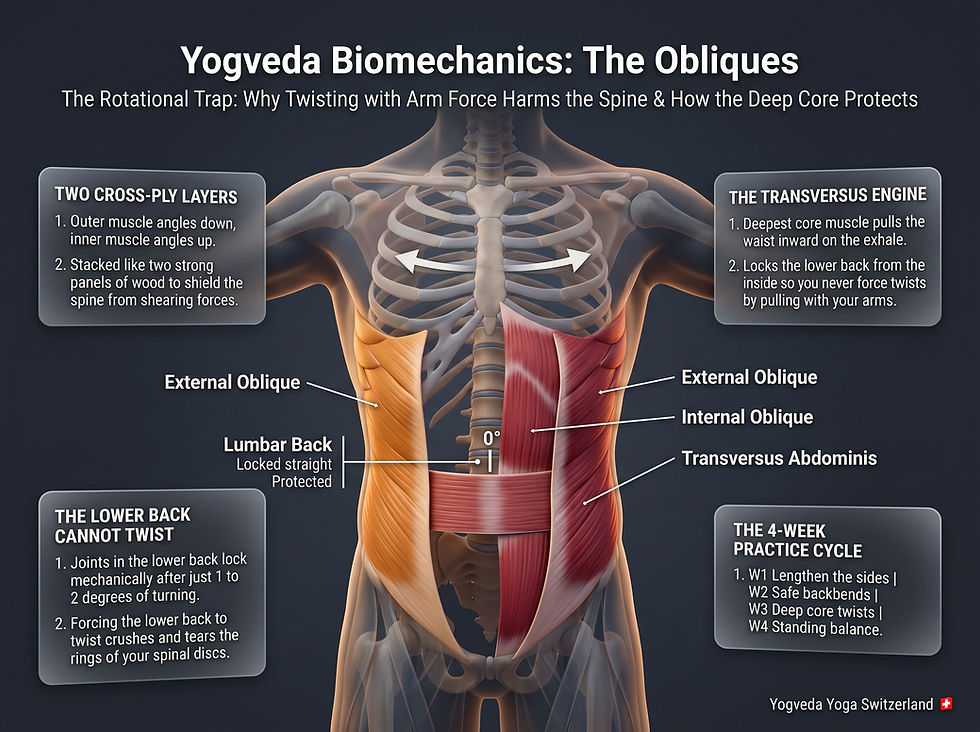
The obliques do not work as a loose muscular mesh. In clinical anatomy, their architecture functions like marine plywood or a modern radial tire: Two solid, distinct muscular sheets are stacked on top of each other, crossing their fiber angles at 90 degrees to neutralize shearing forces from all directions.
A. The Cross-Ply Architecture of the Flanks
The fiber orientation of the obliques forms a resilient cross-ply lattice:
The External Oblique runs downward and inward (inferomedially), identical to the angle of slipping your hands into your coat pockets.
The Internal Oblique sits directly underneath as an independent layer. Its fibers run upward and inward, crossing the external layer at a perpendicular 90-degree angle.
These two muscle sheets do not intertwine. They glide smoothly over one another, separated by loose fascial layers. This cross-ply geometry guarantees that no matter which direction your torso bends or leans, there is always a muscular wall ready to act as a brake to keep your spine safe.
B. The Linea Alba: The Central Woven Seam
While the muscle bellies are solid gliding sheets, their tendons behave differently: As the muscles approach the midline, they transition into broad, flat tendon sheets (aponeuroses).
At the Linea Alba, these tendons do not simply meet edge-to-edge. They physically cross over and under one another in a dense, three-dimensional woven pattern. When violent twisting drills are performed with heavy weights, extreme shearing forces hit this midline seam. The connective fibers grind against one another, stretch out, and tear—leading directly to abdominal wall separation (Diastasis Recti).
2. The Rotational Fallacy: Lumbar Facet Anatomy vs. The Transversus Engine
Mainstream fitness culture teaches that the entire torso was built to rotate equally. Spinal joint anatomy proves the exact opposite.
             [ THE MECHANICAL ROTATIONAL CONFLICT ]
                            │
     ┌──────────────────────┴──────────────────────┐
     ▼                                             ▼
[ TWISTING WITH "BODY STRENGTH" ]         [ YOGVEDA TRANSVERSUS TWIST ]
Arms pull violently on knees              Exhalation activates Transversus
     │                                             │
     ▼                                             ▼
[ Lumbar facets collide at 2° ]           [ Deep corset locks lumbar spine ]
Bony mechanical doorstops slam shut       Vertebrae safely secured at 0°
     │                                             │
     ▼                                             ▼
[ Annular rings shear & tear ]            [ Ribcage rotates freely by 35° ]
50% of disc collagen loses tension        Smooth, pain-free rotation without disc wear
A. The 2-Degree Boundary of the Lumbar Vertebrae
The facet joints of your lower back are positioned vertically in the sagittal plane. They act like heavy doorstops specifically built to block rotation.
A single lumbar vertebra can only turn roughly 1 to 2 degrees before bone crashes into bone. When someone forces their lower back to twist, they crush the protective articular cartilage and strain the joint capsules.
B. Disc Annular Failure: The 50% Loss of Strength
The outer wall of an intervertebral disc (annulus fibrosus) consists of concentric rings of collagen fibers oriented at alternating 30-degree angles.
Because of this criss-cross alignment, a fundamental rule of biomechanics applies: The moment you twist your spine in either direction, exactly half of the disc's collagen fibers go slack. Your spinal disc immediately loses 50% of its load-bearing capacity.
When you perform weighted Russian twists or forced yoga twists:
The lower back bends forward while twisting.
Bending pushes the jelly-like center of the disc backward.
Twisting slacks half the protective outer fibers.
The remaining disc rings tear under pressure, causing disc bulges, herniations, and severe sciatica.
C. The Yogveda Axiom: Twisting from the Transversus Abdominis
In conventional yoga studios, students pull with their hands on their knees or push against the floor, using "the strength of the body" to force themselves into a twist. This external levering destroys the lower back.
In the Yogveda methodology of Master Shahid Khan, external leverage is strictly forbidden:
No pulling with the hands, no wrenching with the shoulders.
The twist is always initiated on a complete exhalation.
As you exhale, the deep Transversus Abdominis contracts, wrapping around your waist like a firm weightlifting belt.
This deep tension firms the lower back and stabilizes intra-abdominal pressure. The lumbar spine is locked motionless at 0 degrees.
Only from this protected base does the thoracic spine turn—which is anatomically designed for 35 degrees of rotation. The twist is powered purely from within, completely protecting your joints.
3. Pathomechanics: Oblique Asymmetry & Pelvic Torsion
Because the obliques connect the lower ribs directly to the pelvis, chronic tension on one side causes a damaging chain reaction throughout the entire skeleton:
4. The Respiratory Deadlock: How Hyper-Toned Obliques Choke Flank Breathing
The obliques are powerful muscles of forced exhalation. When you cough, laugh, or shout, they contract forcefully to pull the ribs down and squeeze air out of your lungs.
When these muscles become permanently tight from improper core training or chronic stress, your ribcage gets trapped in a permanent exhalation state:
               [ THE OBLIQUE RESPIRATORY DEADLOCK ]
                                │
               [ CHRONICALLY TIGHT OBLIQUE FIBERS ]
                                │
                                ▼
         [ RIBS 8–12 PERMANENTLY PULLED DOWN TO PELVIS ]
                                │
                                ▼
       [ BUCKET-HANDLE EXPANSION BLOCKED DURING INHALE ]
        Ribcage Cannot Swing Outward; Lower Lung Bases Starved
                                │
                                ▼
       [ DIAPHRAGM COLLIDES WITH AN IMMOVABLE LATERAL WALL ]
        Air Forced into Neck & Shoulders; Chronic Nervous System Alarm
A. The Lost "Bucket-Handle" Arc
With every healthy breath, your lower ribs (ribs 8 to 12) must swing outward and upward like the handle of a bucket (bucket-handle motion). This creates vacuum pressure in the lower lung lobes.
Because the External Oblique anchors to ribs 5 through 12, a tight oblique acts like a locked ratchet strap around your ribs. The ribcage cannot open. The diaphragm hits an immovable wall, forcing your breath up into your neck and keeping your nervous system in a chronic fight-or-flight response.
5. 3 Diagnostic Clinical Self-Checks for Oblique Biomechanics & Rotational Control
Use these three simple self-checks to find out if your obliques are tight or endangering your spine:
6. The Yogveda Curriculum: The 4-Week Cycle for Oblique Biomechanics & Transversus Twists
In the Yogveda methodology created by Master Shahid Khan, machine twists, sit-ups, and side bends are completely discarded.
The academic year is organized into 12 systematic 4-week cycles. In each 4-week block, the full range of classical postures (āsanas) is practiced with strict focus on one anatomical group and its fascial chains.
In this cycle, the focus is squarely on the rotational axis: stopping destructive twists driven by body strength and mastering rotation powered by the Transversus Abdominis.
       [ THE 4-WEEK CYCLE: OBLIQUE BIOMECHANICS & TRANSVERSUS ]
                                 │
     ┌──────────────┬────────────┴──────────────┬──────────────┐
     ▼              ▼                           ▼              ▼
[ WEEK 1 ]     [ WEEK 2 ]                  [ WEEK 3 ]     [ WEEK 4 ]
FORWARD        BACK                        TWISTING       STANDING
STRETCHES      BENDS                       POSTURES       POSTURES
Flank length   Gentle eccentric            Twisting via   Anti-rotation &
restoration &  lengthening                 Transversus    shear protection
pelvic balance without flaring             (Zero arm pulling) under gravity
Week 1: Forward Stretches — Flank Length & Pelvic Balance
Postural Focus: Lateral forward extensions (Pārśva Upaviṣṭha Koṇāsana, Jānu Śīrṣāsana, Adho Mukha Śvānāsana).
Biomechanical Action: The priority is decoupling the lower ribs from the pelvic bones. Both sitting bones remain firmly rooted to the floor. Extending diagonally over one leg lengthens tight oblique fibers, balances the pelvis, and creates new space between spinal discs.
Week 2: Back Bends — Gentle Lengthening & Freeing the Ribs
Postural Focus: Spinal extensions with diagonal tension (Ūrdhva Dhanurāsana, Camatkārāsana, Dvipāda Pīṭham).
Biomechanical Action: In back extensions, the obliques act as an elastic front brake. The practitioner learns to lengthen the front body without letting the ribs flare or the hips twist. This stretches tight tissue around ribs 8–12 and releases the diaphragm.
Week 3: Twisting Postures — Twisting via the Transversus (No Arm Leverage)
Postural Focus: Classical seated twists (Marīcyāsana III, Ardha Matsyendrāsana, Parivṛtta Pārśvakoṇāsana).
Biomechanical Action: Here, Master Shahid Khan's primary rule is applied: The pelvis remains completely still, and the arms never pull on the knees. On the exhale, the Transversus Abdominis pulls the abdominal wall inward. The lower back is locked safely at 0 degrees. Only then does the thoracic spine turn—powered entirely by deep core muscles, protecting the discs completely.
Week 4: Standing Postures — Weight-Bearing Core Sovereignty
Postural Focus: Dynamic standing postures (Utthita Trikoṇāsana, Parivṛtta Trikoṇāsana, Vīrabhadrāsana III).
Biomechanical Action: Under full gravity, the obliques perform their true function: Anti-Rotation. In postures like Parivṛtta Trikoṇāsana, the Anterior Oblique Sling absorbs rotational forces easily. The spine remains upright, centered, and safe.
The Masterclass Verdict: Inner Core Strength vs. Destructive Levering
Your core is not an engine built to twist your lower spine into destruction. It is an unyielding transmission system designed to transfer power cleanly between the ground and the upper body while keeping your nervous system protected.
The Obliques and Transversus Abdominis form your body's dynamic diagonal suspension system. When you twist using external body strength or violent gym exercises, you destroy your lumbar discs and lock your pelvis in torsion. When you learn to twist from within through the strength of the Transversus Abdominis, you transform your torso into an unshakeable column of spinal safety, rotational freedom, and effortless breath.
In Post 5 of our 8-Week Core, Posture & Breath Series, we descend into the deepest muscular foundation of the human body: Transversus Abdominis — The Inner Corset, Hydraulic Intra-Abdominal Pressure & The Science of Core Breath.
Yogveda Yoga follows the science of the darshanas strictly, no morality, no god worship, study yourself to be free.
👉 Yogveda Asana Lesson : Build the physical presence to distinguish between what is real in the body and what is just a feeling.
👉Yogveda Yoga Teacher Training in Bern: Deepen your understanding of Patanjali's philosophy of mind and truth.
Author, Master Shahid Khan
Yogveda Yoga Switzerland 🇨🇭


Comments