
Yoga Sutra 1.42 Meaning: The Friction of Language (Savitarkā Samāpatti)


तत्र शब्दार्थज्ञानविकल्पैः संकीर्णा सवितर्का समापत्तिः ॥ १.४२ ॥Transliteration: tatra śabdārtha-jñāna-vikalpaiḥ saṅkīrṇā savitarkā samāpattiḥ
The Direct Translation: "In that state, the cognitive fusion (Samāpatti) is mixed with the word, the actual object, and the conceptual knowledge associated with it. This is called Savitarkā Samāpatti (absorption with deliberation)."
1. The Core Meaning of the Words
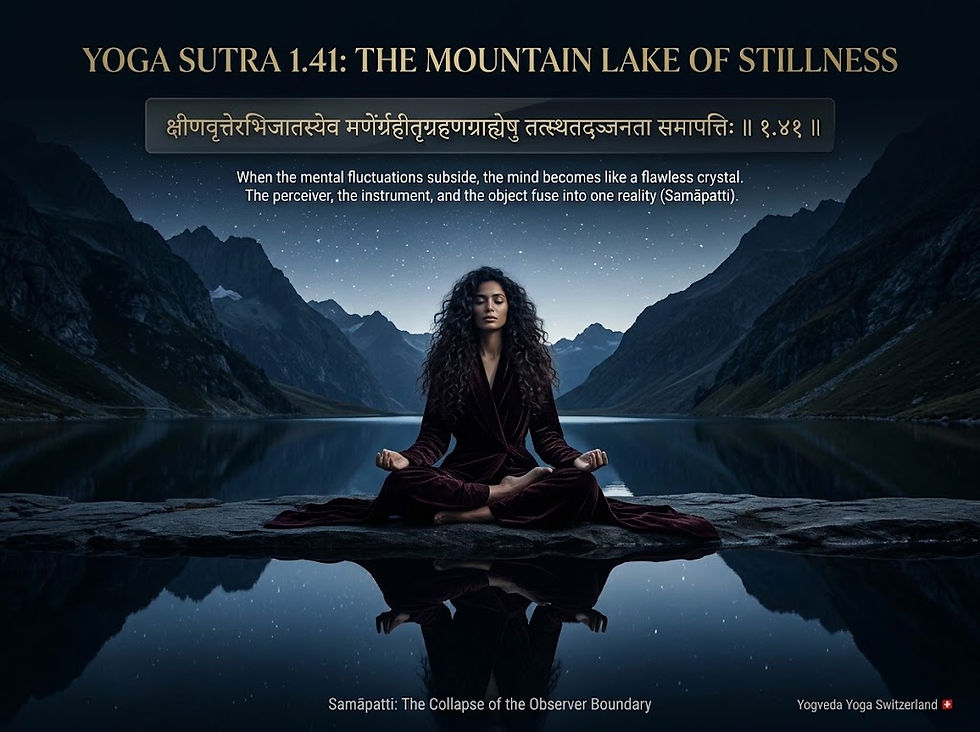
In Sutra 1.41, Patanjali introduced the concept of Samāpatti—the state where the mind becomes a flawless crystal, perfectly fusing with the object of focus. But Patanjali is a clinical pragmatist. He knows the brain does not jump from chaos to absolute perfection in a single step.
In Sutra 1.42, he breaks this cognitive fusion down into stages. He introduces the first, most accessible stage of absorption: Savitarkā Samāpatti.
Tatra (तत्र): There, or in that state.
Śabda (शब्द): The word, name, or sound used to describe something.
Artha (अर्थ): The actual object or true physical reality.
Jñāna (ज्ञान): The cognitive idea, concept, or memory associated with the object.
Vikalpaiḥ (विकल्पैः): By conceptualization, imagination, or verbal delusion (as defined in Sutra 1.9).
Saṅkīrṇā (संकीर्णा): Mixed, mingled, or conflated.
Savitarkā (सवितर्का): With deliberation, logic, or gross analytical thought.
Samāpattiḥ (समापत्तिः): Cognitive fusion or complete absorption.
2. The Illusion of the Label
When you first achieve a state of intense concentration, your mind is stable, but it is not entirely silent. You are still talking to yourself.
In this first stage of absorption (Savitarkā), the mind is successfully locked onto the target, but it is still experiencing semantic friction. The brain cannot stop itself from labeling the experience.
Patanjali states that in this stage, three distinct things are completely mixed up (saṅkīrṇā) in the practitioner's mind:
The Word (Śabda): The linguistic label (e.g., "breath", "muscle").
The Object (Artha): The actual, physical biological reality of the thing.
The Concept (Jñāna): Your personal memories, intellect, and ideas about the thing.
To a stabilized but untrained mind, these three seem like a single event. But they are not. The word is not the object. The menu is not the meal. Savitarkā Samāpatti is a high state of neurological focus, but it is still contaminated by the friction of language.
3. Sage Vyāsa and the Semantic Trap
In his authoritative commentary (Vyāsa Bhāṣya), Sage Vyāsa uses the classic example of a cow to explain this neurological conflation.
When an ordinary person perceives a cow, they instantly mix three things together: the sound/word "cow" (śabda), the actual physical animal standing in the field (artha), and their conceptual knowledge of what a cow is (jñāna). The brain processes this so rapidly that the person believes the word and the animal are the exact same thing.
Vyāsa explains that when a practitioner first enters deep absorption (Samāpatti), they still carry this linguistic habit. If they focus on a biological structure, their mind is still whispering the name of the structure, relying on human language to comprehend universal physics. The crystal of the mind is clarifying, but it is still scratched by words.
4. The Brain Science: The Internal Narrator
┌──────────────────────────────────────────────────┐
│  1. THE FRACTURED PERCEPTION (Ordinary Mind)     │
│  - Wandering attention, high anxiety             │
│  - No fusion with the object                     │
└────────────────────────┬─────────────────────────┘
                         │
             [ Sustained Concentration ]
                         ▼
┌──────────────────────────────────────────────────┐
│  2. SAVITARKĀ SAMĀPATTI (Mixed Fusion)           │
│  - Attention is locked perfectly on target       │
│  - BUT: The Default Mode Network (DMN) and       │
│    language centers remain partially active      │
└────────────────────────┬─────────────────────────┘
                         │
                         ▼
┌──────────────────────────────────────────────────┐
│  3. THE BIOLOGICAL REALITY                       │
│  - The semantic label obscures the pure          │
│    sensory data of the object itself.            │
└──────────────────────────────────────────────────┘
Modern cognitive neuroscience validates this stage of meditation with absolute precision.
When you first stabilize your focus, the brain's Task-Positive Network engages, holding your attention on the target. However, the brain's language processing centers—specifically Broca's area (internal monologue) and the Default Mode Network (DMN) (self-referential thought)—are still firing.
The human brain evolved to categorize raw sensory data using language as a survival mechanism. In Savitarkā Samāpatti, the brain receives pure, bottom-up sensory data from the object, but the cerebral cortex is still desperately trying to apply top-down semantic labels to it. You are experiencing the reality, but you are still narrating it.
5. The Dialogue: Master Khan on the Friction of Language
Student: "Master Khan, you gave us the 15-minute Pranayama protocol to slow the breath to a whisper and achieve Samāpatti. But when I do it, I find myself constantly saying in my head, 'My breath is slow. I am observing the breath. This is the inhale.' Am I failing?"
Master Khan: "You are not failing; you have simply reached the first gate. Patanjali defines this in Sutra 1.42 as Savitarkā Samāpatti. Your attention is successfully locked on the biological engine, but you are still applying semantic friction. You are confusing the word 'breath' (śabda) with the actual structural reality of the air (artha)."
Student: "Why does my mind keep narrating the practice?"
Master Khan: "Because the human ego relies on language to validate its own existence. When you say, 'I am observing my slow breath,' the language centers of your brain are keeping the 'I' alive. The word is an intellectual concept (jñāna), not a biological fact."
Student: "How do I move past this mixed state?"
Master Khan: "You must realize that the biological tissue of your body does not speak English, German, or Sanskrit. Gravity does not have a vocabulary. The breath does not need you to narrate it in order to exist. Continue the protocol. Hold the focus. Eventually, the language centers will exhaust themselves and shut down. When the internal narrator finally dies, the word disappears, and only the pure, unspoken reality of the object remains. But do not jump ahead intellectually. Patanjali details exactly what happens when this linguistic friction is wiped clean in the very next sutra. For today, stay on the mat, hold the 15 minutes, and observe the narrator."
6. Scientific Studies & Classical References
Farb, N. A., et al. (2007). Attending to the present: mindfulness meditation reveals distinct neural modes of self-reference. Social Cognitive and Affective Neuroscience, 2(4), 313-322.
Clinical Relevance: Demonstrates the distinct neurobiological shift from "narrative focus" (language-based self-reference, matching Savitarkā) to "experiential focus" (pure sensory perception without linguistic labeling), confirming Patanjali's stages of cognitive fusion.
Brewer, J. A., et al. (2011). Meditation experience is associated with differences in default mode network activity and connectivity. Proceedings of the National Academy of Sciences, 108(50), 20254-20259.
Clinical Relevance: Proves that sustained meditative focus eventually deactivates the Default Mode Network (DMN), which is responsible for the self-referential "internal narrator" that creates semantic friction.
Lupyan, G. (2012). What you see is what you hear: The pervasive influence of language on perception. Frontiers in Psychology, 3, 215.
Clinical Relevance: Validates Sage Vyāsa's commentary by proving experimentally that linguistic labels (words) actively alter and override pure bottom-up visual and sensory perception, demonstrating how śabda mixes with artha.
Bryant, E. F. (2009). The Yoga Sūtras of Patañjali: A New Edition, Translation, and Commentary. North Point Press.
Classical Reference: Contains Sage Vyāsa’s definitive commentary (Vyāsa Bhāṣya) on Sutra 1.42, detailing the entanglement of word, meaning, and knowledge, and utilizing the classical example of the cow to illustrate semantic confusion in early absorption.
Yogveda Manifesto
Yogveda Yoga is a compiled applied science. I do not follow modern "isms," dogmas, or blind beliefs. Rooted strictly in the classical Darśanas and Ayurveda, I dictate no human morality and teach no god worship. I simply provide the exact tools to study your own biological engine. Freedom is absolute self-knowledge. Study yourself to be free.
👉 Yogveda Asana Lesson : Build the physical presence to distinguish between what is real in the body and what is just a feeling.
👉Yogveda Yoga Teacher Training in Bern: Deepen your understanding of Patanjali's philosophy of mind and truth.
Author, Master Shahid Khan
Yogveda Yoga Switzerland 🇨🇭


Comments