
Mastering Yoga Asanas: Why Geometric Precision is a Clinical Necessity, Not an Option
Are you "listening to your body" during your yoga practice, or are you just listening to years of corrupted neurological habits?
The modern wellness industry constantly repeats the mantra, "listen to your body and do what feels good." Master Shahid Khan considers this the most dangerous advice in modern yoga.
Your body is a highly adaptable biological machine, and it has spent years adapting to sitting at desks, slumping over phones, and walking with asymmetrical imbalances. Your internal map of what "feels right" is already deeply corrupted. Yoga is not an intuitive dance; it is the strict application of physics, biomechanics, and geometry. In Yogveda Yoga, precise geometric alignment is not a stylistic choice or an advanced option. It is a strict orthopedic and neurological necessity.
When you place the human body under the load of gravity, you are dealing with kinetic forces. If you ignore the math, you destroy the joints. Here is the hard scientific reality of why geometric precision is mandatory.
The Principle of Joint Centration
The human skeletal system is designed to bear massive weight, but only when the bones are perfectly stacked. This is the orthopedic principle of Joint Centration.
Joint centration is the exact geometric position where a joint has maximum surface contact. In this mathematically perfect position, the load is distributed evenly, and the correct mechanical stress stimulates bone density. However, when alignment fails by even a fraction of an inch, compressive load instantly converts into shear force—grinding down cartilage, inflaming tissue, and tearing ligaments.
The Clinical Reality: High-Risk Postures and Medical Consequences
Certain asanas magnify gravitational load to extreme levels. In these postures, geometric precision is the only thing standing between the practitioner and severe orthopedic injury:
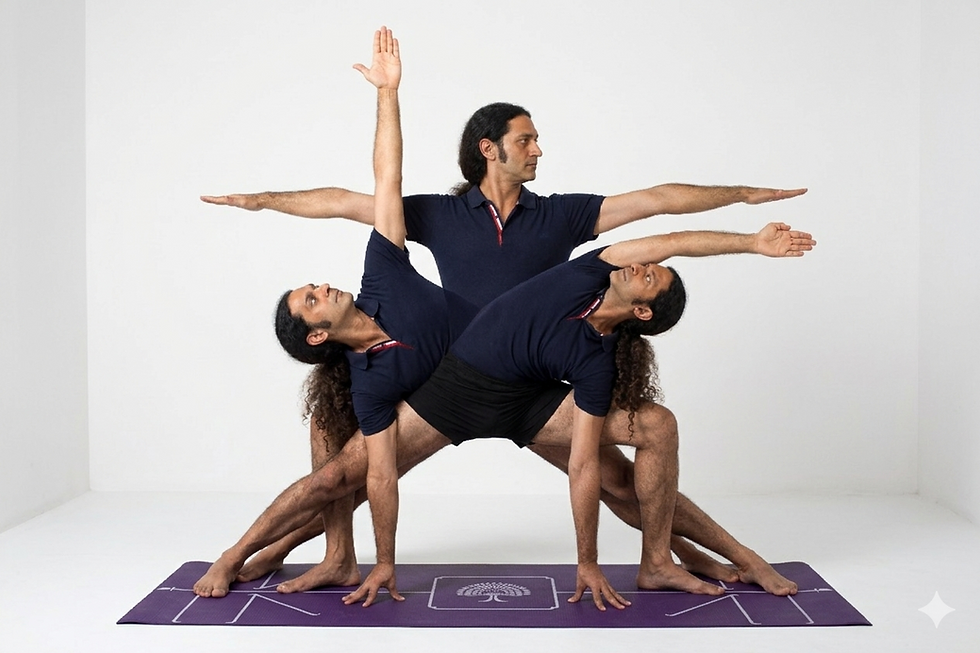
Standing Foundations (Trikonasana, Virabhadrasana II, Parsvakonasana)
In these poses, foot placement must be mathematically perfect. The center of both feet must lie on the exact center line of the mat. Furthermore, the back foot must be angled at exactly 45 degrees. This specific geometry is not aesthetic; it forces the femur head (the hip joint ball) to move upwards, giving the entire body a structural up-lift. If you miss this angle, the femur is forced into a down-lift, which systematically grinds the joint bursa and causes severe, irreversible hip osteoarthritis over the long term.
Intense Forward Flexion (Parsvottanasana)
Achieving the severe geometric shape of this forward fold demands the exact same 45-degree angle foot anchor. The Medical Reality: If the back foot is misaligned, the pelvis cannot neutralize. The extreme forward flexion then places massive asymmetrical load on the Sacroiliac (SI) joint, leading directly to SI joint shear, severe ligamentous laxity, and hamstring avulsion (tearing the muscle directly off the sitting bone).
Standing Twists (Parivrtta Trikonasana, Parivrtta Parsvakonasana)
These are some of the most dangerous postures when executed without precision. The Medical Reality: Twisting a loaded spine without perfect axial extension and an anchored mathematical base turns the spine into a mortar and pestle. The asymmetric rotational load forces the vertebrae to grind together, actively provoking lumbar disc herniations (L4-L5, L5-S1), facet joint syndrome, and severe sciatic nerve compression.
The Upper Kinetic Chain (Adho Mukha Svanasana, Handstand, Pincha Mayurasana)
In load-bearing upper body postures, the fingers and toes must be on the exact same linear plane. Misalignment here breaks the kinetic chain, causing uncontained shear force to bypass the muscles and tear directly into the rotator cuff and labrum, causing chronic shoulder impingement.
Inversions (Sirsasana, Sarvangasana)
The exact same strict linear geometry applies. If the center line is lost while the body is inverted, the massive asymmetric load crushes the cervical spine, leading to bulging cervical discs and permanent neurological trauma.
The Neurological Trap: Proprioceptive Deficit
Why can't you just "feel" your way into a perfect 45-degree angle or a perfect center line to avoid these injuries? Because of a neurological condition known as a proprioceptive deficit.
Proprioception is your Central Nervous System’s (CNS) ability to sense where your body is in space. However, if you have spent a decade walking with a slightly rotated pelvis, your brain rewires itself to accept that crooked posture as "normal." When a wellness teacher tells you to align your feet based on feeling, your brain automatically stops you at your familiar, crooked baseline. True geometric alignment often feels awkward at first because you are forcing the CNS to remap a broken system.
The Required Solution: Objective Measurement
Because your internal sensors lie to you, you cannot rely on them. You must use an objective, external metric to force your anatomy into the correct mathematical angles.
This is the exact clinical reason The Yoga Mat was engineered in Switzerland. The laser-precise geometric grid on the mat removes the neurological guesswork. You do not place your feet where they "feel right"; you lock the center of your feet onto the center line, and you align your back foot perfectly with the 45-degree marker. The mat forces your kinetic chain into mathematically perfect angles, guaranteeing the hip "up-lift" and eliminating destructive shear force, regardless of what your habituated nervous system is telling you.
Yoga is applied physics. Treat it with the respect it demands. If you are a practitioner tired of guessing and risking injury, or a yoga teacher who wants to understand the hard orthopedic science behind every adjustment, it is time to elevate your standard. Stop teaching feelings and start teaching biomechanics. Join the 200h academic standard at Yoga University Switzerland.
Do you practice such precision in your yoga studio?
👉 Yogveda Asana Lesson : Build the physical presence to distinguish between what is real in the body and what is just a feeling.
👉Yogveda Yoga Teacher Training in Bern: Deepen your understanding of Patanjali's philosophy of mind and truth.
Author, Master Shahid Khan


Comments