
Following Your Heart: Unmasking the Ultimate Biochemical Delusion
Welcome to Part 5, the final chapter of our clinical teardown of the cardiovascular system.
Over the last four posts, we stripped away the sentimental marketing fluff of the commercial wellness industry to examine the unyielding physics of your central pump. We analyzed how shallow breathing suffocates the myocardium, how refined sugar acts as a slow metabolic poison, how internal pressure tears at heart valves, and how a locked diaphragm short-circuits the heart's electrical grid.
Today, we address the ultimate cardiovascular delusion: the psychological, emotional, and hormonal drama we project onto this organ.
In modern society, individuals constantly justify reckless, destructive, and objectively foolish life decisions under the banner of following your heart. Whether it is dismantling a stable relationship, abandoning an essential duty, or executing an impulsive financial blunder, the "heart" is utilized as an unassailable shield against reason. But basic human physiology and classical yoga science prove that your heart is innocent. It is not an emotional oracle; it is a muscular slave to your endocrine system, your unstable mind, and raw socio-economic survival mechanisms.
Why Following Your Heart is Pure Sympathetic Panic
When someone claims they are making a profound, soul-centered choice because they are choosing to engage in following your heart during an emotional crisis, what are they actually experiencing on a purely physiological level?
Chitta Vrittis and Autonomic Hyper-Reactivity
They are experiencing a somatic reflection of an uncalibrated Autonomic Nervous System. Your heart is an involuntary muscle packed with beta-adrenergic receptors. It does not generate independent emotional wisdom or intuitive guidance. When your mind is unstable, flooded with unexamined desires, anxieties, or projections (Chitta Vrittis), the brain stem triggers an immediate sympathetic survival response.
Adrenaline and cortisol flood the bloodstream in sharp bursts.
Your heart rate spikes uncontrollably.
Your stroke volume increases drastically.
Smooth muscles constrict, creating a tight sensation across the chest.
This is not cosmic guidance or a spiritual compass. This is a textbook biological panic attack. When you make a life-altering choice based on that neurovegetative flutter in your chest, you aren't following a spiritual path—you are letting an unstable, hyper-reactive mind hijack your mechanical pump to validate an irrational fight-or-flight impulse.
The Love Drama: It's Hormones, Not the Heart
The intense emotional high of infatuation or obsessive partner-centered fixation does not originate in the heart chambers. It is the result of a violent neuroendocrine hijacking. What mainstream culture romanticizes as the mystical "inner voice" that manifests when following your heart is simply an uncalibrated flood of chemicals firing from your brain and adrenal glands:
Dopamine & Phenylethylamine: Create an obsessive, hyper-focused state of craving while completely shutting down the logical filters in your prefrontal cortex.
Oxytocin: Forces a blind, uncritical attachment to an external object, completely bypassing rational risk assessment.
The Absurdity of Ownership: "I Gave You My Heart"
This neurochemical fog breeds the most linguistically and logically absurd phrase in modern romance: "I gave you my heart." Let us apply rigorous clinical reality to this statement. You cannot give your physical heart to another human being unless you are sliced open on an operating table under the care of a team of transplant surgeons. Your heart remains firmly anchored inside your thoracic cavity by the great vessels, performing a purely mechanical function.
The entire premise of romantic transactional ownership is a comedy of cognitive failure. If you engage in following your heart to the point of "giving it away" and the relationship dissolves, what is the protocol? Do you send a legal notice to demand your heart back? What if that person refuses to give it back? Are you expected to walk around with a hollow, empty space in your chest cavity because your ex-partner keeps your myocardium in their apartment?
This highlights the sheer irrationality of the unstable mind. The ego creates these impossible, hyper-dramatic metaphors to avoid taking responsibility for its own attachments, projecting its psychological desperation onto a completely innocent circulatory organ.
Why Following Your Heart is a Business Merger
When we strip away the pink sunglasses of Hollywood, we must confront a radical truth: from an evolutionary, historical, and sociological standpoint, the romanticized concept of "true love" is an incredibly recent, highly commercialized luxury. For thousands of years, human relationships were openly recognized for what they actually are: agreements of convenience, security, and pure economics.
The Evolutionary Economics of Pair-Bonding
From a biological perspective, pair-bonding was never about finding a soulmate. It was a cold calculation of resource management and risk mitigation. Raising a human infant—the most helpless and resource-heavy offspring in the entire animal kingdom—required a strict economic division of labor. What society defines as a spiritual calling when following your heart is simply the neurochemical glue the brain synthesized to force two organisms to stay together long enough to protect a genetic investment. It is an economic syndicate disguised as romance.
The Transactional Contract of the Ego
If you look at modern relationships under a clinical microscope, the moment the convenience or economic parity dissolves, the "love" usually goes with it. The ego (Ahamkara) sets up an implicit, unwritten business contract:
“I will provide you with status, financial security, lifestyle convenience, or reproductive viability, and in return, you will provide me with validation, social standing, or domestic support.”
The moment one party defaults on this internal spreadsheet—due to financial ruin, loss of status, or aging—the other party files for emotional bankruptcy. If love were a mystical, cosmic force independent of the ego, it would remain unaffected by these variables. Because it is highly dependent on them, it proves that worldly love is just an agreement of convenience and economics.
The Theater of Illusion: The Drama Requires a Fool
The grand theater of romantic drama requires a very specific psychological architecture to function: it demands at least one fool. For a cold, transactional agreement of convenience and economic alignment to be successfully repackaged as a cosmic, star-crossed destiny, the mind must willingly enter a state of absolute cognitive surrender. The „fool“ is the uncalibrated mind (Manas) that mistakes a transient chemical high for spiritual validation, eagerly signing a contract written by the ego (Ahamkara) while pretending it is receiving directives from the heavens.
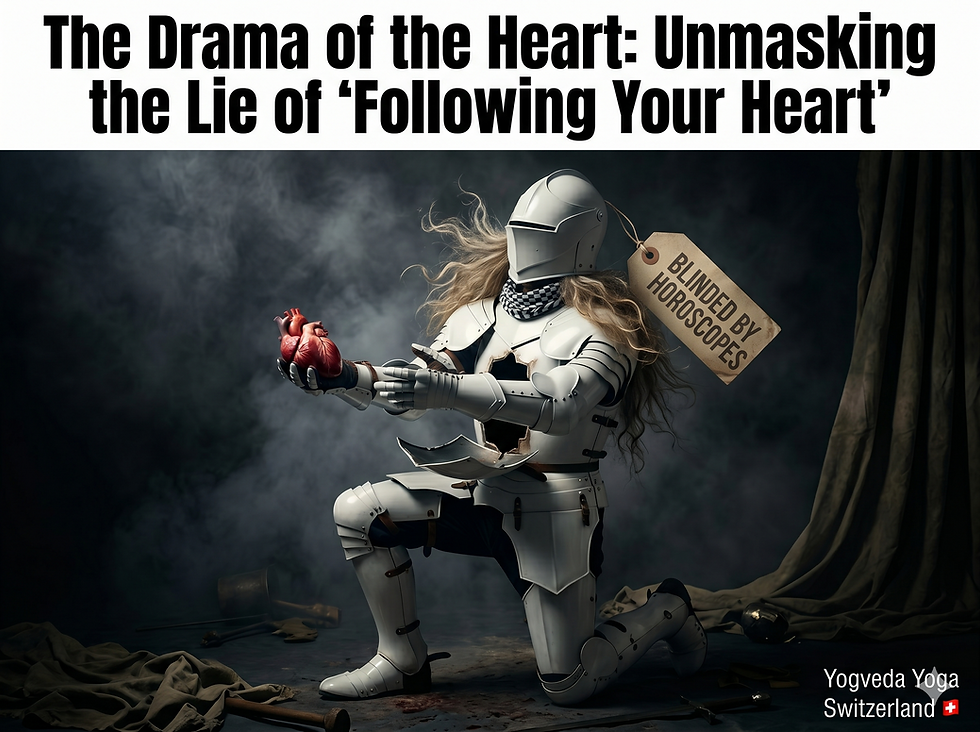
To compound this farce, the modern fool frequently relies on the absolute absurdity of astrological compatibility to rationalize their relational trainwrecks. When two incompatible egos inevitably clash over broken transactions, they completely escape accountability by blaming the alignment of distant gas giants. They pore over generic star-sign charts, weeping that “he is a Scorpio” or “Mercury is in retrograde,” as if the thermonuclear reactions of stars billions of light-years away give a single damn about their text-message drama. This cosmic scapegoating is the ultimate evasion technique of an unstable mind. It attributes the friction of a poorly negotiated socio-economic merger to the zodiac, rather than admitting its own psychological blindness. The moment you play the fool and read the horoscopes to justify your chaos, you choose to let your biological pump be held hostage by an emotional script you wrote yourself.
The Heartbreak Drama: Ego Rejection and Neurogenic Stunning
When the business contract collapses, the psychological theater shifts to the ultimate drama: "heartbreak." People lock themselves in dark rooms, weeping that their heart has been physically smashed into pieces. Again, let us correct the science. Your heart is an organic muscle made of interlocking cardiomyocytes; it does not splinter because someone stopped texting you back. What you are actually experiencing is the brutal trauma of ego rejection.
In classical yoga science, the ego is known as Ahamkara—the identity-manufacturing machine. When an external object rejects your Ahamkara, your ego experiences it as an immediate threat to its survival. The brain registers this psychological rejection in the exact same neural pathways as physical pain.
Instantly, the brain violently cuts off your dopamine and oxytocin supply, plunging you into chemical withdrawal, while simultaneously detonating a massive, toxic bomb of stress hormones (catecholamines) into the bloodstream. This neurochemical storm overstimulates the autonomic nerves wrapping around your cardiac tissue. In extreme clinical cases, this causes Takotsubo Cardiomyopathy—or "broken heart syndrome."
But look at the actual mechanics: it is a neurogenic myocardial stunning. The left ventricle literally balloons out and paralyzes because it has been blasted by stress chemicals from the brain. Your heart is not the source of the grief; it is the physical victim of it. Your ego threw a massive tantrum, your brain fired the neurochemical weapon, and your innocent heart took the bullet.
The True Heart: Deconstructing the Anahata Mechanics
We must move past the sentimental pop-culture distortion that the heart chakra (Anahata) is a fluffy, weeping garbage can for emotional drama. Classical tantric science defines Anahata as "the unstruck sound."
In physics, a "struck" sound requires friction, collision, and duality—two distinct entities colliding to create noise and agitation. The hormonal love drama and ego entitlement we have debunked is struck sound—it is the friction of your ego rubbing against an external object. An unstruck sound is a state of pure, self-existent vibration. It requires no friction, no external object, and no reaction.
Anahata is not an emotional sensor; it is a functional organ of absolute neutrality, non-dual resonance, and unshakeable stillness.
The Mechanics of Non-Dual Compassion
Anahata is the chakra of true human compassion and love, but it has zero relation to the word’s common association with attachment, romance, and symbiotic need.
Sentimental Love (Struck Sound): "I love you because of how you make me feel. If you stop doing that, my love stops." This is conditional, egoic trade.
Anahata Compassion (Unstruck Sound): This is a profound, non-dual resonance with all existence. You are compassionate not because you feel sad, but because your system is in a state of self-existent stillness that recognizes the inherent suffering of duality in another. It is objective, resolute, and unwavering, requiring zero validation or emotional return.
Differentiating Genuine Visceral Bonds and Grief
We cannot ignore that genuine, visceral love and grief exist, creating powerful physical resonance in the heart. However, we must apply scientific sobriety to their nuances:
Paternal and Maternal Love: Mainstream wellness idealizes this as "unconditional." Biologically, it is the highest form of conditional love. Evolution forces a parent to love a child to ensure genetic survival. It is conditional upon the child being theirs. This bond is powerfully hormonal (oxytocin), yet it can approximate Anahata compassion when a parent genuinely sacrifices with no expectation of return. But we must be honest: at its pure physical core, it is still an evolutionary survival imperative, not a spontaneous, non-dual resonance.
Grief Over Death: When a loved one dies, the heart aches intensely. This is not the ego rejection panic we debunked. Genuine grief is the somatic resonance of love in the face of absolute, permanent absence. It is the physical body vibrating with the vacuum left by the loss of another vessel of consciousness. This profound resonance is a mechanism of the Anahata chakra—it is the unstruck sound reacting to the striking absence. It is heavy, powerful, and clinically can strain the myocardium, but the origin is love, not egoic panic.
The Heart is Just a Speaker System
Your heart has no internal brain to process love, longing, rejection, or morality. It is, however, packed with beta-adrenergic receptors that are hyper-sensitive to this neurochemical cocktail. When the brain dumps these chemicals into the bloodstream—whether during infatuation, a parent's oxytocin surge, a genuine grief resonance, or the crash of ego rejection—your heart rate spikes, your stroke volume shifts, and your chest tightens.
That flutter or ache in your chest is not a spiritual guidepost—it is the mechanical echo of an intense physiological or metaphysical resonance. It is a biological loudspeaker box. When you make a life-altering choice based on that feeling, you aren't following a cosmic compass; you are letting wild horses run your life and using your innocent pump to validate the impulse.
The Ancient Science: The Secret Cave of the Katha Upanishad
To understand the true spiritual sovereignty of the heart, we must return to the strict historical science of the Katha Upanishad, one of the most authoritative ancient texts on human consciousness.
In this text, the heart is identified as Hridaya Guha—the "secret cave of the heart." The Upanishad states that deep within this inner chamber resides the Atman, the immortal Soul or the true Self. It describes this spark of consciousness as a smoke-free flame the size of a human thumb (Angustha Matra), burning steadily and completely independent of the ego, the intellect, and the hormonal or somatic fluctuations of the mind-body apparatus.
The Anatomy of a Chariot Crash
To explain how a human being should navigate life, and why the process of following your heart into emotional impulsivity destroys the human vessel, the Katha Upanishad delivers the famous Chariot Analogy:
The Atman (Soul): The passenger sitting quietly in the back of the chariot.
The Body: The physical chariot itself.
The Buddhi (Intellect): The driver holding the reins.
The Manas (Mind): The reins themselves.
The Senses: The wild, powerful horses pulling the chariot.
When you justify a poor decision by saying "the heart wants what it wants," look closely at the architecture of the chariot. The wild horses (your senses) have run after an impulsive trigger. Your mind (the reins) has snapped into a chaotic state, completely overwhelming your intellect (the driver). The driver has dropped the reins, and the horses are dragging the chariot over a cliff.
The passenger—the true dweller in the heart—is trapped in a vehicle spinning out of control. The heart is not the driver. The heart is the quiet chamber where the passenger sits. When you claim to be following your heart while letting your hormones and senses dictate your actions, you have fired the driver, broken the reins, and allowed wild horses to destroy your life.
Reclaiming the Authoritative Center
True cardiovascular and spiritual health means establishing absolute order inside the torso so that the mind can settle into the secret cave of the heart. You cannot experience the stillness of the Atman or the pure, neutral resonance of Anahata if your diaphragm is paralyzed, your blood is thick with toxic sugar, and your nervous system is trapped in a permanent flight-or-fight hormone spiral.
Here is where the precise functional mechanics of the body intervene, based on the 3 Motors of Breath (Nose, Throat, Diaphragm):
The Lumbar Space: By deliberately opening the lumbar space (L1 to L3), we biomechanically remove mechanical pressure from the sympathetic chain.
The Throat Vacuum: Dropping the diaphragm under active abdominal resistance generates a powerful physical throat vacuum that immediately stimulates the vagus nerve, manually lowering myocardial velocity.
Left-Sided Exhalation Neurology: Enforcing strict nasal breathing and executing targeted exhalations through the left nostril directly activates the parasympathetic architecture of the brain stem. This cuts off the ego’s adrenaline cascades at the source.
By mastering this biomechanical framework, you drop the heart rate, dissolve the hormonally induced flutters, and firmly hand the reins back to the intellect (Buddhi). Only when the mechanical pump is completely calm can the mind dissolve its illusions, allowing you to act not from emotional, egoic, or hormonal impulse, but from the unshakeable, silent authority of the soul.
Before you make your next impulsive decision and blame it on your heart, stop and look into the mirror of your biology. Are you genuinely honoring the quiet dweller in the secret cave, or are you just letting wild horses run away with your chariot?
👉 Yogveda Asana Lesson : Build the physical presence to distinguish between what is real in the body and what is just a feeling.
👉Yogveda Yoga Teacher Training in Bern: Deepen your understanding of Patanjali's philosophy of mind and truth.
Author, Master Shahid Khan


Comments