
Reject Blind Faith: How Ancient Indian Science Used Logic to Dismantle Dogma


To understand why true freedom requires dismantling external dependency, we must reclaim the original blueprint of the ancient Indian intellectual tradition. Contrary to mainstream religious narratives, classical Indian thought was not an impractical philosophy or a culture of blind faith. It was a rigorous, multifaceted empirical science of reality, natural laws, human biology, and consciousness.
1. Pramāṇa: The Science of Valid Knowledge (The Mandatory Starting Point)
Before any school of thought was allowed to debate reality, morality, or the mind, all agreed on one non-negotiable rule: epistemology (the science of how we prove what is true) is mandatory. This is known as Pramāṇa-Vāda.
Not a single classical tradition began by asserting: "Believe in God first." Every tradition—orthodox and autonomous alike—demanded that any claim about reality must be validated through legitimate instruments of knowledge (Pramāṇas). Blind belief was never accepted as proof.
                          [ THE 3 CORE PRAMĀṆAS ]
                                     │
       ┌─────────────────────────────┼─────────────────────────────┐
       ▼                             ▼                             ▼
 [ PRATYAKṢA ]                  [ ANUMĀNA ]                   [ ŚABDA ]
Direct Sensory Perception     Logical Deduction &        Verified Expert Testimony
& Empirical Observation       Scientific Inference       (never accepted blindly)
The 3 Universal Instruments of Proof
1. Pratyakṣa (Direct Empirical Perception): Verified observation via biological sensory faculties and clear mental awareness. Universally accepted by all nine schools as the foundational ground.
2. Anumāna (Logical Inference): Valid deduction based on invariant cause-and-effect patterns (e.g., inferring fire from the presence of smoke). Accepted by eight schools as an essential cognitive tool.
3. Śabda / Āptavacana (Verified Expert Testimony): Data from an acknowledged expert who has directly verified the fact; accepted only when logically consistent and empirically testable, never as unquestioned dogma.
2. The Science of the Vedas: Authorless Natural Laws (Apauruṣeya) and the 6 Auxiliary Sciences (Vedāṅgas)
Modern religion treats the Vedas as "holy scriptures dictated by a creator god." Classical Indian science treated them as the exact opposite: Apauruṣeya, meaning "authorless"—systematic observations of natural and acoustic laws that operate independently of human or divine personalities, just like gravity or thermodynamics.
To study these phenomena without personal bias or linguistic distortion, ancient thinkers established the 6 Auxiliary Sciences (Vedāṅgas)—the mandatory technical disciplines required before making any assertion about reality:
                         [ THE 6 VEDIC SCIENCES (VEDĀṄGAS) ]
                                          │
       ┌──────────────┬───────────────────┼───────────────────┬──────────────┐
       ▼              ▼                   ▼                   ▼              ▼
   [ ŚIKṢĀ ]     [ VYĀKARAṄA ]       [ NIRUKTA ]         [ CHANDAS ]     [ KALPA & JYOTIṢA ]
Bio-Acoustics &  Grammatical Logic   Etymological Rigor  Oscillatory     Applied Physics, Geometry
Phonetics        & Linguistic Law    & Semantics         Rhythms         & Observational Astronomy
1. Śikṣā (Bio-Acoustics & Phonetics): The physics of sound production, resonance frequencies, and how specific vocalizations stimulate the central nervous system.
2. Vyākaraṇa (Linguistic Logic & Grammar): The mathematical codification of language, eliminating ambiguity so logical errors cannot hide behind vague words.
3. Nirukta (Etymological Science): The precise root origin of every term, preventing the dogmatic reinterpretation of scientific words.
4. Chandas (Metrics & Wave Frequencies): The mathematical measurement of rhythm, breath cycles, and oscillatory frequencies in physiological states.
5. Jyotiṣa (Observational Astronomy & Mathematics): The empirical measurement of time cycles, planetary movements, and seasonal shifts.
6. Kalpa (Applied Geometry & Procedural Physics): Spatial design, geometric algorithms, and systematic physical protocols.
The Vedas were not books of prayer; they were practical manuals mapping cosmic and physiological order (Dhṛ).
3. The Origin of the Word "Hinduism": A Geographic Label Turned into Religion
To deconstruct the collapse of ancient Indian science, we must examine the history of the word "Hindu" and the modern construct called "Hinduism."
                       [ THE ETYMOLOGICAL EVOLUTION ]
   SANSKRIT: Sindhu ──► OLD PERSIAN: Hinduš ──► GREEK: Indos ──► BRITISH COLONIAL: "Hinduism"
   (The Indus River)     (Geographic Region)     (Land of India)    (Invented "Ism" / 18th–19th C.)
The Word "Hindu" Is Not Found in Ancient Sanskrit Texts
You can search the entire Vedic corpus, the 108 Principal Upanishads, Patanjali’s Yoga Sūtras, the six Darśanas, the Bhagavad Gītā, and the Brahma Sūtras—the word "Hindu" does not appear a single time.
Ancient practitioners never identified themselves as "Hindus" practicing a religion called "Hinduism." They categorized knowledge by specific scientific methodologies (Darśanas like Sāṅkhya, Nyāya, or Yoga) or referred to natural cosmic order as Sanātana Dharma (the eternal operational law of reality).
A Purely Geographic Marker
The term originated outside India as a geographic identifier:
The Sanskrit Root: The Indus River was named Sindhu (meaning river/ocean).
The Persian Shift: In Old Persian (Achaemenid inscriptions of King Darius I, c. 500 BCE), the initial "S" was replaced by "H," creating Hinduš—referring strictly to the geographic region beyond the Indus River.
The Arab & Greek Usage: The Greeks used Indos, and early Arab travelers used Al-Hind to describe the people living in that geographic territory, regardless of their diverse philosophical or scientific stances.
The Colonial Invention of "Hinduism"
The suffix "-ism" was manufactured in the late 18th and early 19th centuries by British colonial administrators.
Operating on European theological templates (where every population must have one book, one founder, and one god), colonial census takers grouped all non-Muslim, non-Christian inhabitants under a single artificial umbrella: "Hinduism."
By turning a geographic identifier into an institutional "religion," centuries of empirical, non-theistic sciences were flattened into dogmatic, faith-based belief systems.
4. The Debate of Kingdoms: Intellectual Supremacy Over Military Might
In ancient India, the prestige of an empire was not measured solely by military conquest, but by its intellectual and scientific supremacy.
Kings competed by hosting grand assemblies of debate (Shāstrārtha). A kingdom was considered backward if its court relied on blind superstition, and advanced if it attracted the sharpest minds capable of defending their models of reality using pure logic (Pramāṇa).
                      [ THE ROYAL ARENA OF DIALECTICS ]
   KINGDOM A (Debater)  ◄────── [ PUBLIC SHĀSTRĀRTHA ] ──────►  KINGDOM B (Debater)
   • Must define terms (Lakṣaṇa)                               • No scriptural dogmas
   • Must provide proof (Pramāṇa)                             • Loser adopts winner's model
The Story of Aṣṭāvakra: Truth Beyond Surface Appearances
The historical debate at the court of King Janaka illustrates this rigorous standard:
A young sage named Aṣṭāvakra, whose body was physically deformed in eight places, entered the royal assembly where the empire's most renowned scholars sat. Seeing his twisted limbs, the entire court erupted in laughter.
Aṣṭāvakra laughed back even louder. When King Janaka asked why he was laughing, Aṣṭāvakra exposed their superficial thinking:
"I thought I was entering an assembly of wise investigators of reality. Instead, I find myself surrounded by cobblers (Charmakāras)—men who only judge the quality of skin and leather, completely blind to the unconditioned consciousness (Svarūpa) within."
Aṣṭāvakra then took the stage against Vandin, the undefeated court scholar, and systematically dismantled the established dogma using pure logic and direct empirical deduction.
The standard was absolute: Authority, age, social prestige, and physical appearance mean nothing. Truth is determined exclusively by valid proof (Pramāṇa) and uncorrupted awareness.
5. The Master Matrix: The 6 Classical Foundations and 3 Autonomous Sciences
Ancient Indian inquiry developed through nine monumental systems (Nava Darśanas). Across all nine systems, not a single one demanded the submissive worship of an anthropomorphic creator god. All paired rigorous logic with a practical method for achieving Kaivalya (the absolute sovereignty of unconditioned awareness).
                      [ ANCIENT INDIAN EPISTEMOLOGY ]
                                     │
              ┌──────────────────────┴──────────────────────┐
              ▼                                             ▼
   [ THE 6 CLASSICAL FOUNDATIONS ]               [ THE 3 AUTONOMOUS SCIENCES ]
        (Ṣaḍ-Darśana / Āstika)                      (Direct Inquiry / Nāstika)
   Engaged with the Vedic corpus                 Relied strictly on direct perception,
   for systemic science and logic                bypassing all traditional authority
              │                                             │
              └──────────────────────┬──────────────────────┘
                                     │
                                     ▼
                       [ THE SHARED VERDICT ON GOD ]
            Anthropomorphic god-worship is rejected across systems.
          The deity concept is either an abstract tool or non-existent.
Part A: The Ṣaḍ-Darśana (Six Classical Foundations)
1. Sāṅkhya (Kapila): Strict dualistic analysis separating Consciousness (Puruṣa) from Matter (Prakṛti). Strictly non-theistic (Nirīśvara); rejects the existence or logical necessity of a creator deity. Freedom is complete discernment (Viveka) of pure consciousness from matter.
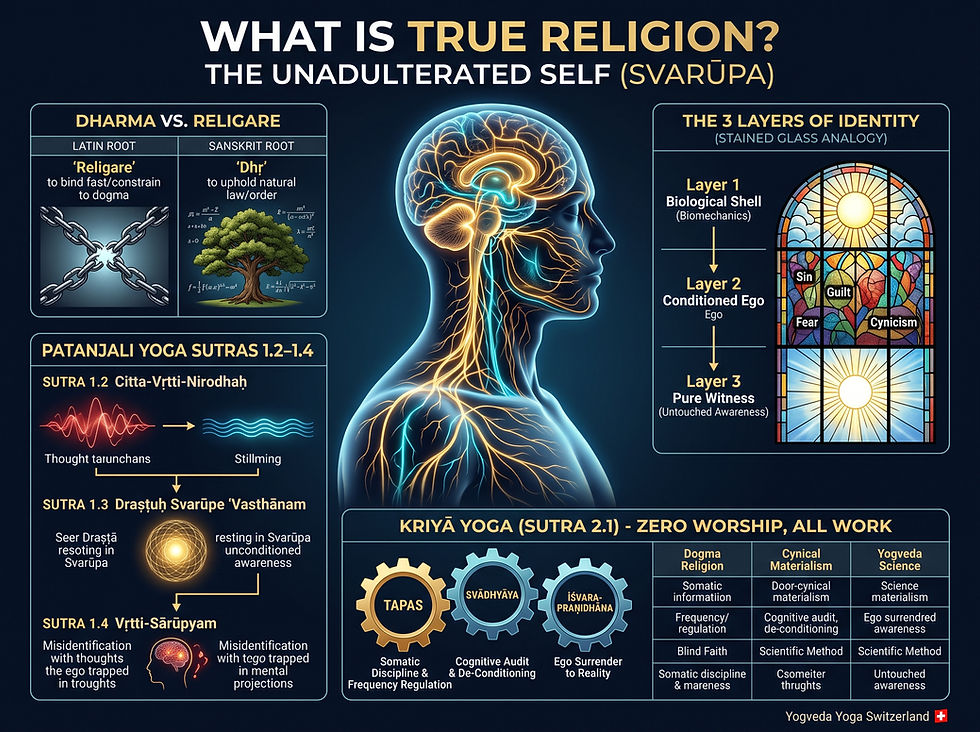
2. Yoga (Sage Patañjali): Applied cognitive engineering and somatic regulation (Citta-vṛtti-nirodha). Non-theological; Īśvara is an optional archetype of untouched awareness used as a focal tool. Freedom is bio-acoustic calibration via Praṇava (Oṁ) to clear physiological obstacles (Antarāyas).
3. Nyāya (Sage Gautama): Formal logic, critical debate methodology, and epistemic proof (Pramāṇa). Truth is established only through proof (Tarka), never blind faith or prayer. Freedom is the eradication of cognitive delusion via strict logic.
4. Vaiśeṣika (Sage Kaṇāda): Atomic theory, physical taxonomy, and natural laws of physics. The universe operates through mechanical causal physics and atomic interactions (Paramāṇu), not divine intervention.
5. Mīmāṁsā (Jaimini): Linguistic science, hermeneutics, and the mechanics of causal action (Karma). Explicitly non-theistic; actions yield direct results via causal natural law (Apūrva). Deity worship is rejected.
6. Vedānta (Upanishads): Non-dual inquiry into the absolute nature of consciousness (Advaita). Non-dual (Nirguṇa); there is no separate "God" outside the universe. You are the underlying ground of existence (Aham Brahmāsmi).
Part B: The 3 Autonomous Sciences (Nāstika Schools)
7. Cārvāka / Lokāyata: Radical empirical materialism and rational skepticism. Completely rejects gods, heavens, hells, and rituals as unproven institutional deceptions. Freedom is sovereignty in life through sensory reality (Pratyakṣa).
8. Buddhism (Siddhārtha Gautama): Phenomenological deconstruction of identity (Anattā) and dependent origination (Pratītyasamutpāda). Explicitly rejects an eternal creator god, a static ego-soul (Ātman), and sacrificial rituals. Nirvāṇa is extinguishing psychological craving and delusion through self-directed mental discipline.
9. Jainism (Mahāvīra): Pluralistic realism, radical non-violence (Ahiṁsā), and multi-faceted truth (Anekāntavāda). The universe is uncreated and eternal; no supreme deity can grant salvation. Kevala Jñāna is absolute liberation achieved exclusively through personal discipline and self-mastery.
6. The Historical Collapse: When, How, and Why Ancient Science Degraded into Cultic God-Worship
If the entire philosophical foundation of ancient India was built on direct inquiry, logic (Pramāṇa), and cognitive sovereignty, how did it transform into millions of idols, superstitious rituals, and passive deity worship?
The degradation was a calculated historical collapse driven by political incentives, economic exploitation, and the destruction of intellectual institutions.
                           [ THE ANATOMY OF COLLAPSE ]
                                        │
        ┌───────────────────────────────┼───────────────────────────────┐
        ▼                               ▼                               ▼
    [ WHEN ]                         [ HOW ]                         [ WHY ]
Historical Timeline &           Systematic Destruction          Economic & Political
Key Epochs of Decline           of Empirical Standards          Incentives for Control
WHEN Did the Collapse Occur?
The Post-Gupta & Early Medieval Transition (c. 600–1100 CE): The rise of feudal monarchies and agrarian temple cartels. Abstract scientific principles were personified into localized temple deities to anchor land grants and secure feudal tax revenues.
The Era of Institutional Destruction (c. 1193–1300 CE): The catastrophic burning of major university centers (Nalanda, Takshashila, Vikramashila). The destruction of massive libraries and debate masters wiped out the public culture of scientific debate (Shāstrārtha).
The Colonial and Neo-Hindu Distortion (c. 1800–Present): British administrative classifications forced Indian sciences into the mold of a Western theistic religion ("Hinduism"), while modern pop-spirituality reduced neurobiology and biomechanics into superficial wellness trends.
HOW Was the Scientific Framework Dismantled?
Extinction of Public Debate (Shāstrārtha): With university centers destroyed, formal logic (Nyāya) was removed from common education. Assertions were no longer tested via proof (Pramāṇa); they were accepted through clerical authority.
Personification of Scientific Principles: Complex biological, astronomical, and psychological formulas were converted into literal stone idols. Bio-acoustic sound tuning (Oṁ) became a mystical chant; anatomical alignment became magical ritual.
Replacement of Viveka with Submissive Bhakti: Intellectual inquiry (Viveka) and somatic effort (Tapas) were replaced by emotional begging and devotional surrender (Bhakti divorced from its philosophical roots).
Manufacture of Intermediary Gatekeepers: Hereditary priesthoods monopolized access to texts, translating natural laws into divine commandments that required paid ritual mediation.
WHY Was the Collapse Engineered?
The Commercial Incentive (Monetizing Dependency): You cannot monetize a sovereign human being. Telling someone: "You are complete; regulate your nervous system, audit your mind, and master your biology" generates zero revenue. Converting life into sin, guilt, and posthumous fear creates an endless market for paid salvation.
Cognitive Fatigue (Buddhi Bhrashṭi): Empirical inquiry and nervous system mastery require hard personal labor (Pauruṣa). It is biologically easier for the human brain to outsource agency to an imaginary deity than to perform the rigorous work of daily somatic and mental deconditioning.
7. The Political Weaponization of Faith: Divide, Manipulate, Rule
Once an institution successfully abolishes critical thinking and demands blind submission, the population loses its cognitive defense mechanisms. A society stripped of logical discernment (Viveka) is easily reduced to a mass of blind followers.
Ruling elites recognized that a thinking population is difficult to control, but a believing population can be easily weaponized. Religion was hijacked from a science of self-mastery into the ultimate tool for political division and manipulation:
Manufacturing Loyalty Through Manufactured Fear: Rulers frame political conquest and state policies as "divine mandates." Questioning political authority is branded as a cosmic sin (Adharma).
Division via Religious Tribalism: By manufacturing imaginary existential threats against the faith or the deity, political cartels activate the limbic fear system of the population. Fear suppresses the rational analytical capacity of the prefrontal cortex, securing unquestioned obedience.
Degradation of Human Agency: The human being, originally intended to achieve absolute sovereignty (Kaivalya), is downgraded into an emotional foot soldier manipulated for electoral and territorial power.
Whenever direct knowledge (Jñāna) is abandoned, inquiry inevitably degenerates into a cult of obedience.
8. Yogveda Yoga: Reclaiming Vedic Science & Pramāṇa in Modern Practice
Today, the modern yoga industry has largely forgotten this intellectual heritage. It has reduced a profound epistemic science to either shallow gymnastic stretching ("McYoga") or superstitious lifestyle consumerism.
Yogveda Yoga restores classical Indian science to its rightful place.
                       [ THE SCIENTIFIC RESTORATION ]
   MODERN MCYOGA / POP SPIRITUALITY   ──►   YOGVEDA YOGA APPLIED SCIENCE
   • "Just trust your feelings"             • Test reality through direct proof (Pramāṇa)
   • Mystical energy claims                 • Measure biomechanics & autonomic regulation
   • Blind devotion to modern gurus         • Build self-sufficient cognitive sovereignty
Instead of asking you to surrender your intellect, Yogveda Yoga grounds your practice in verifiable proof:
Empirical Biomechanics: Postures are aligned according to joint physics, fascial tensegrity, and skeletal mechanics rather than dogma.
Autonomic Physiology: The breath is trained through the three mechanical motors of respiration to measurably balance sympathetic and parasympathetic states.
Cognitive Discernment (Viveka): The mind is trained to separate biological sensation from psychological stories, freeing consciousness (Svarūpa) from unconscious conditioning.
Moving Beyond Blind Faith
Ancient Indian science did not ask you to drop to your knees in fearful worship. It challenged you to stand up, sharpen your intellect, and observe reality with uncompromising clarity.
You do not need a priest to interpret the universe, and you do not need a politician to define your morality.
When you master the instruments of valid proof (Pramāṇa), regulate your nervous system, and still the turbulence of the mind, your true nature reveals itself—self-luminous, whole, and completely free.
In Part 5 of our series "The God Game," we will explore the final piece of the puzzle: Deconstructing the "Afterlife Economy"—why ancient priesthoods invented heaven, hell, and guilt, and how to live fully in the reality of the present moment.
👉 Yogveda Asana Lesson : Build the physical presence to distinguish between what is real in the body and what is just a feeling.
👉Yogveda Yoga Teacher Training in Bern: Deepen your understanding of Patanjali's philosophy of mind and truth.
Author, Master Shahid Khan
Yogveda Yoga Switzerland 🇨🇭


Comments