
What Is True Religion? Why Your Consciousness Needs No God or Guru
When we step away from churches, temples, deity idols, commercial wellness gurus, and even the stance of those who say, "I don't believe in anything," a fundamental question arises: What is left?
For many, this question creates deep discomfort or complete indifference. Society conditions us to believe that without a supreme cosmic ruler, holy books, or priesthoods, human existence collapses into moral chaos. Others use passive disbelief as an intellectual shield—too mentally lazy to do the rigorous work of self-examination, confusing simple cynicism with actual freedom.
Classical Indian science cuts straight through both traps with a clear, uncompromising answer: Everything that is real remains.
Strip away political power struggles, threats of punishment, the commercial wellness marketplace, and lazy cynicism, and the core reality of human existence is revealed: the unconditioned consciousness (Svarūpa) observing reality as it is, free from distortion.
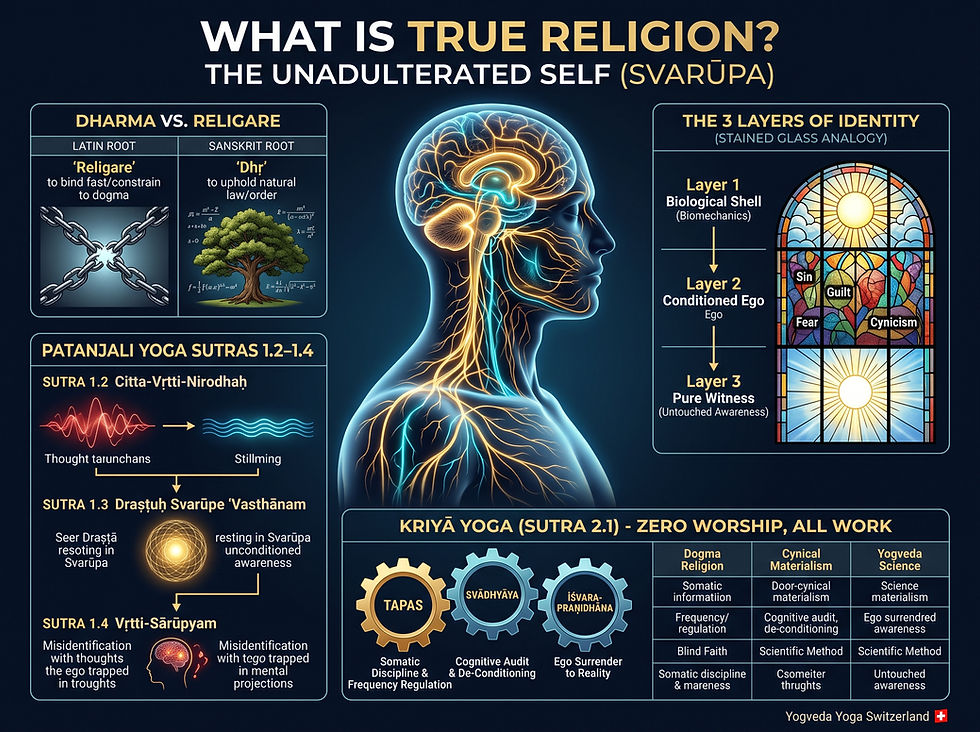
1. The Linguistic Mistake: Religare (To Bind) vs. Dharma (Natural Order)
Much of our modern confusion comes from a basic translation error: equating the Sanskrit word Dharma with the Western concept of "Religion."
These two words represent opposing approaches to human life.
   [ WESTERN "RELIGION" ]                 [ CLASSICAL "DHARMA" ]
    Latin Root: RELIGARE                   Sanskrit Root: DHṚ
    "To bind fast / To tether"             "To uphold / To sustain"
               │                                      │
   Binds the individual to                Describes the intrinsic natural order
   an external dogma and church           of reality and the human mind
Religion (Religare): Built on an act of tethering. It requires you to bind your thinking to an unproven text, a historical authority, and a governing hierarchy.
Dharma (from the root Dhṛ): Means that which supports and maintains natural balance. The Dharma of fire is heat; the Dharma of water is fluidity; the Dharma of human consciousness is to see reality clearly without psychological delusion.
Dharma has no single founder, demands no worship, threatens no damnation, and requires no blind belief. You do not need to "believe" in gravity—you observe how it works.
2. What Is "God"? Defining the Concept vs. The Reality
Because the word "God" is central to this inquiry, we must define what the word actually means—and what it has been used to justify.
The Standard Definition of God
Standard lexicons (such as the Oxford English Dictionary and Merriam-Webster) define God by three primary attributes:
A Supreme Being / Creator: An all-powerful entity regarded as the creator, governor, and judge of the universe.
A Personified Moral Authority: An entity with emotional traits (wrath, jealousy, mercy) who demands obedience, worship, and devotion.
An Intervener in Nature: A power that alters natural laws, grants miracles, forgives sins, and rewards or punishes human actions in this life or an afterlife.
                    [ THE THEOLOGICAL "GOD" CONCEPT ]
   CREATOR / RULER ──► DEMANDS WORSHIP & OBEDIENCE ──► REWARDS / PUNISHES
                                    │
                    Requires intermediaries (priests/gurus)
                    and the surrender of human reason.
The Psychological Mechanism
Psychologically, the traditional concept of God is an externalized authority figure—an all-powerful parent in the sky onto whom humans project their deepest fears of mortality, uncertainty, and injustice. By placing ultimate authority outside of the individual, institutions make themselves the essential middlemen.
The Classical Indian Distinction: Creator God vs. Īśvara
In classical Indian science (Sāṅkhya and classical Yoga), there is no creator-god micro-managing the universe. Nature (Prakṛti) operates by its own mechanical, self-governing laws.
When Patanjali uses the term Īśvara in Yoga Sutra 1.24, he does not describe a creator deity who created the world or demands praise. Īśvara is defined strictly as a blueprint of pure, untouched consciousness (Puruṣa-viśeṣa)—an archetype of awareness that has never been colored by ignorance, fear, or mental conditioning. You do not pray to Īśvara for favors; you use this baseline as a reference point for your own mental clarity.
3. Patanjali’s Blueprint: Consciousness Resting in Its Own Nature
In the opening lines of the Yoga Sutras, Patanjali defines the entire science of human liberation in three direct statements without a single theological dogma:
[ SUTRA 1.2 ]  Yogaḥ Citta-Vṛtti-Nirodhaḥ
               "Yoga is the intentional stilling of mental turbulence."
                                    │
                                    ▼
[ SUTRA 1.3 ]  Tadā Draṣṭuḥ Svarūpe 'Vasthānam
               "Then the Seer (Consciousness) rests in its true, natural state."
                                    │
                                    ▼
[ SUTRA 1.4 ]  Vṛtti-Sārūpyam Itaratra
               "At all other times, awareness confuses itself with its thoughts."
The Observer vs. The Mental Noise
Patanjali separates the observer from the mental noise:
The Seer (Draṣṭā): The quiet, underlying awareness that observes life. It is not an emotion, not a thought, and not a soul that needs saving.
The Thoughts & Reactions (Vṛttis): The constant stream of fears, societal conditioning, dogmas, and automatic impulses running through the brain.
The Mistake (Vṛtti-Sārūpyam): When you falsely assume that you are your fear, your anger, your religious identity, or your social status.
True Religion, in its original scientific meaning, is simply Sutra 1.3: the state where your awareness stops reacting to external conditioning and rests calmly in its unadulterated baseline (Svarūpa).
4. The 3 Layers of Identity: The Stained Glass Analogy
To understand why consciousness needs no outside savior, consider pure sunlight passing through a stained glass window.
   ┌─────────────────────────────────────────────────────────────┐
   │ 1. THE BODY (Deha)         │ Physical body and senses       │
   ├────────────────────────────┼────────────────────────────────┤
   │ 2. THE EGO (Ahaṅkāra)      │ The stained glass:             │
   │                            │ Dogmas, guilt, cynicism, fear  │
   ├────────────────────────────┼────────────────────────────────┤
   │ 3. THE OBSERVER (Draṣṭā)   │ The pure, uncolored sunlight   │
   └────────────────────────────┘
If the glass is painted red with religious fear, the light on the floor looks red.
If the glass is painted dark with cynical apathy, the room looks pitch black.
Traditional religion, modern wellness, and cynical disbelief spend all their time arguing over the glass. One tells you the glass is sinful; another charges you money to polish the glass; the cynic claims the glass is all that exists and gives up entirely.
Classical science looks directly at the source. It recognizes that the light itself was never stained. Your core awareness was never broken, was never sinful, and needs no external ritual or guru to be whole.
5. Zero Worship Does Not Mean Zero Work: The Action of Transformation (Kriyā Yoga)
Rejecting external gods does not mean sitting back in passive comfort. Saying "I don't believe in anything" does not make you free; it just leaves your unconscious conditioning untouched.
Classical Yoga makes it clear that discovering your unconditioned nature requires deliberate, active work. In Yoga Sutra 2.1, Patanjali provides the three practical tools required to clear mental distortions: Tapas, Svādhyāya, and Īśvarapraṇidhāna.
                     [ THE 3 ENGINES OF TRANSFORMATION ]
                                      │
       ┌──────────────────────────────┼──────────────────────────────┐
       ▼                              ▼                              ▼
   [ TAPAS ]                   [ SVĀDHYĀYA ]              [ ĪŚVARAPRAṆIDHĀNA ]
Physical discipline to       Relentless self-study        Surrendering ego to
calm the nervous system      to spot false conditioning   pure, uncolored awareness
1. Tapas: The Discipline of Practice
Transformation requires real physical and mental effort (Tapas—meaning the heat generated by discipline). You cannot think clearly if your body is exhausted and your nervous system is trapped in chronic stress. Tapas is the intentional training of the body, breath, and focus to break compulsive habits and build physical stability.
2. Svādhyāya: Self-Study to Remove False Programming
Svādhyāya is an honest, critical audit of your own mind. It is the work of identifying everything in your thinking that is non-Dhṛ—the borrowed dogmas, family conditioning, irrational fears, and emotional biases that cloud your judgment. You study your reactions the way a scientist studies facts.
3. Īśvarapraṇidhāna: Aligning with Pure Reality
As established, Īśvara is not a creator deity demanding flattery. Īśvarapraṇidhāna is not begging an external entity for help. It is letting go of the arrogant, fearful ego (Ahaṅkāra) and aligning yourself fully with objective truth and your own clear nature (Svarūpa).
6. Yogveda Yoga: The Scientific Bridge from Dogmatic Suppression to True Self-Sovereignty
For centuries, humanity has been caught between two dead ends: suppressive, belief-based religions on one side, and aimless, cynical materialism on the other.
Belief-based systems demand that you suppress your critical intellect, accept manufactured guilt, and surrender your agency to priests or commercial gurus. Materialistic cynicism rejects religion but offers zero practical tools to regulate the nervous system or master the mind.
Yogveda Yoga is the scientific bridge between these two extremes.
                       [ THE YOGVEDA BRIDGE ]
   BELIEF-BASED RELIGION  ──►  [ THE YOGVEDA METHOD ]  ──►  TRUE-SELF SOVEREIGNTY
   • Suppressed intellect      • Applied Biomechanics        • Clear Perception (Viveka)
   • Fear, Guilt, & Dogma      • Breath & Nervous System     • Direct Reality (Pramāṇa)
   • External God/Guru         • Cognitive Audit (Svādhyāya) • Untouched Awareness (Svarūpa)
Instead of asking you to believe, Yogveda Yoga provides a repeatable, science-based methodology to free your true self:
From Blind Faith to Biomechanics: Replacing mystical rituals with the precise mechanics of posture, spinal alignment, and joint stability.
From Emotional Pleading to Autonomic Regulation: Replacing passive prayer with clinical breath mechanics (Pranayama) to shift the nervous system out of chronic threat and into calm, high-level executive function.
From Religious Dogma to Epistemic Proof (Pramāṇa): Replacing borrowed doctrines with direct observation, logical verification, and self-evident reality.
By treating the human body and mind as an integrated physiological instrument rather than a sinful vessel, Yogveda Yoga dismantles external dependence and restores your inherent capacity for self-governance.
7. System Comparison: Dogmatic Faith vs. Lazy Cynicism vs. The Yogveda Bridge
Area | Institutional Dogma | Cynical Disbelief ("Believe in Nothing") | The Yogveda Scientific Solution |
Core Attitude | Blind faith in books and priests. | Passive apathy; dismissing everything without inquiry. | Active self-discipline (Tapas) and observation. |
Approach to Mind | Submits human reason to doctrine. | Avoids deep thinking; relies on reactive opinions. | Relentless self-study (Svādhyāya) to clear false ideas. |
Source of Truth | External authorities and deities. | Personal mood, cynicism, and social trends. | Direct observation, evidence, and logic (Pramāṇa). |
View on "God" | An external judge demanding worship. | A myth to mock while ignoring inner conditioning. | The blueprint of unconditioned awareness (Īśvara). |
Daily Practice | Rituals, prayers, and financial tithes. | Zero effort; constant mental reactivity. | Applied biomechanics, breath regulation, mental clarity. |
Final State | Dependence on a promised afterlife. | Emotional confusion and mental stagnation. | Complete cognitive freedom and autonomy in the present. |
The Path to Sovereign Awareness
True religion builds no temples, enforces no dogmas, demands no tithes, and settles for no cynical excuses.
It is the disciplined, daily science of Tapas (training the body and nervous system), Svādhyāya (dismantling borrowed illusions), and Īśvarapraṇidhāna (aligning completely with reality). It demands no worship, but it demands your total commitment to truth.
In Part 4 of our series "The God Game," we will examine the historical proof: The 9 Classical Indian Traditions, the epistemology of valid proof (Pramāṇa), and why ancient systems systematically rejected the concept of a creator god.
👉 Yogveda Asana Lesson : Build the physical presence to distinguish between what is real in the body and what is just a feeling.
👉Yogveda Yoga Teacher Training in Bern: Deepen your understanding of Patanjali's philosophy of mind and truth.
Author, Master Shahid Khan
Yogveda Yoga Switzerland 🇨🇭


Comments