
Yogveda Journal Vol. 38: The Clinical Neuroscience of Taste (Ayurveda Rasa)


Welcome to the Yogveda Journal, Vol. 38. 2026.
The commercial wellness industry has reduced nutrition to caloric counting, emotional comfort, and superficial diet trends, while the industrial food complex replaces actual biological nourishment with laboratory-engineered, ultra-processed compounds. They sell you the illusion that taste is merely a personal preference. Let me state the clinical truth immediately: We absolutely reject this. Chronic illness is not a biological default. You never need to be sick. In classical Ayurveda, taste (Rasa) is not a culinary option; it is direct neurochemical data.
In this edition, we discard the diet myths and examine Ayurvedic nutrition through the strict lens of clinical neuroscience. You do not eat to comfort yourself emotionally. You eat to fundamentally rewire the endocrine architecture of your body.
The Biological Prerequisite for Metabolic Stability
What exactly is a "taste," and why is its clinical understanding the absolute biological prerequisite for metabolic health? Taste is a direct biological trigger. When matter hits your tongue, a strict physiological cascade begins immediately, forcing your cranial nerves to send electrical signals directly into your brain.
Without this neurochemical understanding, you are biologically trapped in the toxic cycles of the modern food industry. A healthy, sovereign life cannot be achieved through calorie counting when your body remains structurally programmed for chronic inflammation and insulin toxicity. True metabolic stability requires the physiological capacity to control the endocrine system and decouple from the toxic triggers of industrial food. If you cannot consciously alter the chemical signals you send to your body, you cannot change your reality. You remain a permanent hostage to the automatic reactions of your metabolism.
The Neurochemical Architecture of Nutrition
Every bite you consume, every craving, and every inflammatory reaction you experience is not a coincidence; it is a mechanical instruction sent to your biology. You cannot simply wish chronic illness away, and you cannot think your way out of metabolic dysfunction.
The brain receives taste data and instantly forces your glandular system to secrete specific hormones like insulin, adrenaline, or cortisol. To truly transform your body, you must literally alter the chemical inputs governing your central nervous system. Classical Ayurveda provides the exact mechanical framework to do this.
Systemic Pharmacological Intervention
This is a precise, biological intervention. First, through the targeted application of the six Rasas (Sweet, Sour, Salty, Pungent, Bitter, and Astringent), you actively hack your system. In clinical Ayurveda, these are not flavors, but highly potent pharmacological interventions. Each taste dictates a specific physiological response: it forces the body into either anabolic tissue growth, catabolic tissue breakdown, systemic inflammation, or cellular constriction.
As the practice deepens, true biological realignment begins. Through relentless, mechanical control over your nutrition, you uncouple from unconscious reactions and force the system into absolute, disease-free stability.
This is not a diet. It is the quantifiable, structural perfection of human biology.
Author, Master Shahid Khan
Yogveda Yoga Schweiz 🇨🇭
The Masterclass Articles in this Edition

Ayurveda Madhura Rasa: Clinical Neuroscience The sweet taste (Madhura Rasa) is not merely sugar; it is the most powerful anabolic signal in nature. We examine how this taste forces tissue growth and how its modern overconsumption leads directly to metabolic stagnation and fatal insulin toxicity.
Click on the image or here to read the blog.

Ayurveda Amla Rasa: The Clinical Neuroscience of the Sour Taste and Systemic Inflammation Sour (Amla Rasa) stimulates digestion, but its biochemical price is high. Learn how overstimulation from sour signals attacks the mucosal linings of the stomach and lungs, triggering systemic inflammatory responses throughout the body.
Click on the image or here to read the blog.

Ayurveda Lavana Rasa: The Clinical Neuroscience of the Salty Taste and Cardiovascular Hypertension Salt (Lavana Rasa) forces the body into water retention and tissue expansion. This analysis deconstructs the mechanics of how the salty taste dominates kidney function and drives chronic cardiovascular hypertension.
Click on the image or here to read the blog.

Ayurveda Katu Rasa: The Clinical Neuroscience of the Pungent Taste and Neurogenic Inflammation Pungent (Katu Rasa) is not a taste, but a pain response that stimulates the nervous system. Discover the aggressive mechanics behind spicy food and how it causes heart racing, leaky gut, and severe neurogenic inflammation.
Click on the image or here to read the blog.

Ayurveda Tikta Rasa: The Clinical Neuroscience of the Bitter Taste and Nervous System Depletion Bitter (Tikta Rasa) is the ultimate catabolic signal, breaking down tissue and purifying the body. However, we examine the clinical danger of overdose: how excessive bitter compounds literally dry out and deplete the central nervous system.
Click on the image or here to read the blog.
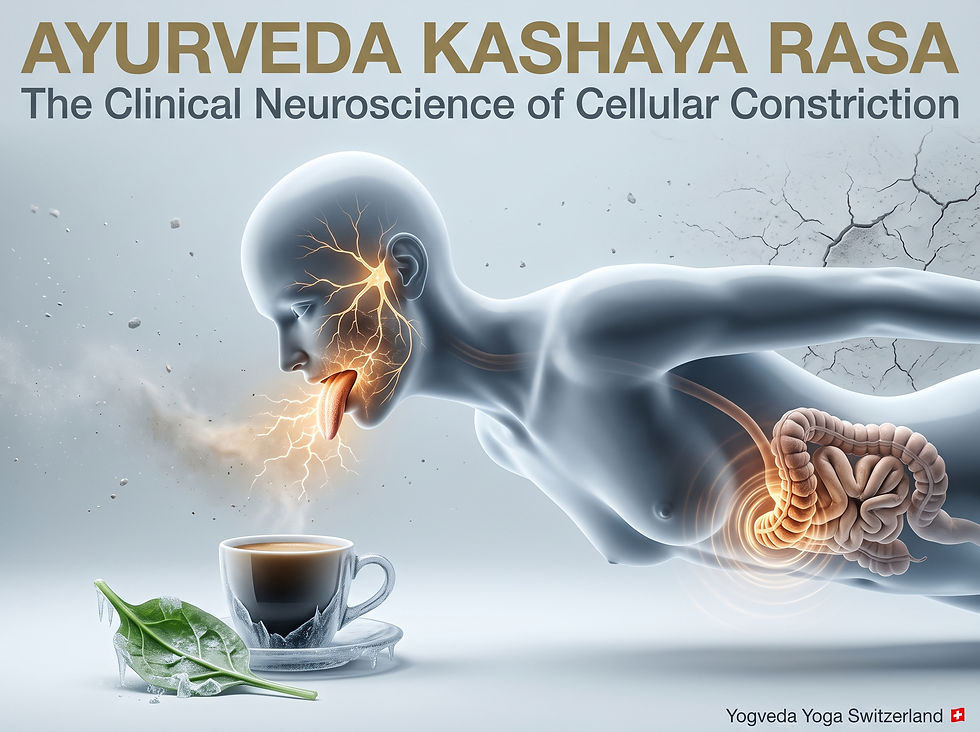
Ayurveda Kashaya Rasa: The Clinical Neuroscience of the Astringent Taste and Cellular Constriction Astringent (Kashaya Rasa) acts as a biological brake. This masterclass explains how the astringent taste absorbs water, forces cellular constriction, and creates physical blockages within the biological channels.
Click on the image or here to read the blog.


Comments